

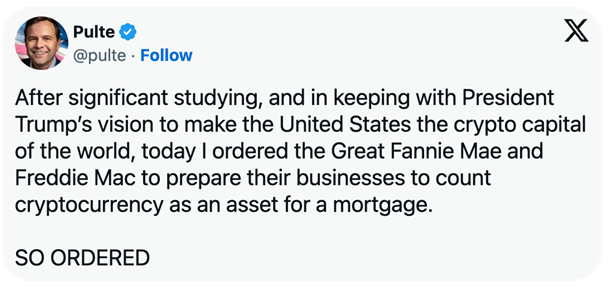
Under Director William J. Pulte (a Trump nominee), the U.S. Federal Housing Finance Agency (FHFA) has issued a directive that could make home financing easier. Fannie Mae and Freddie Mac are being asked to integrate cryptocurrency holdings into mortgage qualification metrics. This high-level mandate, announced via X (formerly Twitter) on June 25, instructs Fannie and Freddie to “create a system to count cryptocurrency as an asset for mortgages,” aligning with President Trump’s vision of the U.S. becoming the “crypto capital” of the world.
What the Directive Changes
Under previous administrations, crypto assets were considered too volatile and risky to be considered in mortgage applications. The recommendation is that they be considered as reserves or supplemental borrower assets. Previously, they would have to be converted to fiat first. The FHFA’s core instruction tasks the GSEs with preparing proposals to include crypto holdings (without mandatory conversion to U.S. dollars) as part of single-family mortgage loan risk assessments. To qualify, the holdings must be “stored on a U.S.-regulated centralized exchange,” ensuring custody and auditability.
Technical Implications for Mortgage Underwriting
1. Asset Verification Integrations
Mortgage lenders and the GSEs must now adapt their Automated Underwriting Systems (AUS), to integrate with exchange custodians, pulling real-time or near real-time wallet balances. The challenge lies in ensuring data integrity, timestamping, and synchronizing with loan-level underwriting timelines.
2. Volatility and Risk Modeling
Crypto assets remain volatile. Underwriters will require risk-adjusted valuation models, potentially implementing haircuts (e.g., 30–50%) to convert crypto reserves into usable asset value. This aligns with standard practices already in place for non-liquid assets like retirement accounts. Pulte’s directive acknowledges this need, urging inclusion of “volatility mitigants and reserve adequacy checks” in the proposed underwriting criteria.
3. Regulatory Compliance
Integrating digital assets may require updates to regulations under RESPA (Real Estate Settlement Procedures Act) and TILA (Truth in Lending Act) to clarify disclosure norms, settlement procedures, and escrow requirements. Moreover, AML/KYC protocols around crypto custody must be robust enough to satisfy both FHFA and AML regulatory regimes.
Broader Policy and Market Context
This technical pivot is part of a larger FHFA overhaul. Shortly after being confirmed by Congress in March, Pulte restructured the boards of Fannie and Freddie, signaling broader shifts toward privatization and modernization. The crypto directive falls into this narrative, sending a political signal ahead of the 2026 election cycle: President Trump and his appointees are aggressively reorienting housing finance toward fintech innovation.
Risks and Operational Concerns
Critics warn that exposing housing finance to crypto could recreate 2008-style systemic risk if not properly managed. Key concerns include valuation gaps during sharp price corrections and uneven lender implementation, potentially creating fragmented qualification standards. Others draw parallels to private crypto-collateralized home loans that could scale quickly under GSE backing.
What Comes Next
Fannie and Freddie are expected to submit formal proposals detailing:
-
Accepted asset classes (e.g., Bitcoin, Ethereum, stablecoins)
-
Exchange and custody eligibility criteria
-
Volatility-adjustment mechanisms
-
Technology integration plans for AUS systems
From there, a formal FHFA review and board sign-off will follow before implementation can begin. While the directive does not yet change policy, it clearly establishes crypto as a legitimate asset class in conventional mortgage underwriting and places the GSEs at the forefront of financial innovation.
You might also like: