
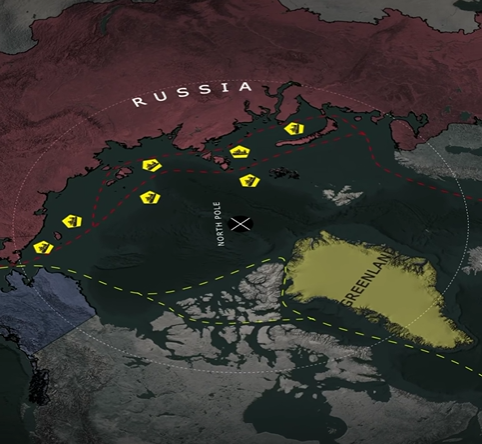
 Why Greenland Matters: Greenland could be America’s ultimate Arctic advantage—strategic, military, and geopolitical power in one frozen territory… Greenland may seem remote, but its strategic location, military potential, and Arctic resources make it a linchpin for U.S. geopolitical influence.
Bitcoin Signals Market Global Risk Sentiment :
With U.S. equity markets closed for Martin Luther King Jr. Day, Bitcoin became the only available proxy for global risk sentiment and sold off sharply on fears of potential tariffs on Europe. Those fears were tied to headlines surrounding President Trump’s renewed interest in acquiring Greenland, either through negotiation or force.
Not the First Time
The idea that Greenland matters is not new. The United States has explored acquiring Greenland before. After purchasing Alaska from Russia in 1867, Secretary of State William H. Seward also evaluated the strategic merits of Greenland and Iceland. At the time, Benjamin Peirce, Superintendent, U.S. Coast Survey, compiled a government report touting the advantages of acquiring both Greenland and Iceland (i.e., large amounts of fish, game, and minerals). In 1868, negotiations by Seward for purchasing both Greenland and Iceland from Denmark for $5.5 million in gold were reportedly “nearly complete,” but ultimately Congress failed to act… mostly due to a lack of public support.
Like today, in 1868, the public was unconvinced of the advantages and gave the Alaska purchase the name “Seward’s Folly”, but history ultimately proved the Alaska acquisition to be one of the most strategically and economically valuable decisions the U.S. ever made.
This isn’t even the first time the U.S. has bought land from Denmark. In 1917, as the U.S. entered WWI, it faced the threat of German expansion in the Atlantic. So the United States purchased the American Virgin Islands from Denmark for $25 million in gold. Unlike Alaska, this deal drew little public excitement. The strategic logic was clear: control of key maritime routes in the Caribbean and protection of the approaches to the Panama Canal.
In the years since, the Virgin Islands became an important naval and logistical foothold during both World Wars. Like Alaska and the Louisiana Purchase, the Virgin Islands demonstrate a recurring pattern in U.S. history, i.e., territorial acquisitions driven by forward-looking strategic concerns that appeared quiet or controversial at the time, but demonstrated their value over time.
In WWII, the U.S. established a military base in Greenland, and after the war, the U.S. offered $100 million in gold to buy Greenland. But again the deal fell through, this time because Denmark refused, citing sovereignty and national pride.
Why Greenland Matters?
Anyone who has ever played the board game RISK understands why Greenland matters. Greenland is a strategic keystone between North America, Russia, and China. It sits along the shortest air and missile routes between Russia and the United States and serves as a natural choke point for transatlantic access. Geography remains destiny in geopolitics, and despite the cold, Greenland’s geographical location is becoming even more critical.
The strategic stakes in Greenland go far beyond theory. Russia has built approximately 32 “continuously attended military sites” including submarine bases, deepwater ports (with ice-breakers), airfields, and radar stations, projecting power from its northern coast to remote islands. Russia has also refurbished and reopened dozens of Soviet?era outposts, rebuilding at least 50 air bases, radar stations, border outposts, and related facilities to bolster its Arctic presence. And the U.S. has one, Thule Air Base for missile warning, space surveillance, and Arctic defense.
As Moscow expands its Arctic footprint and China eyes the region, Greenland’s value skyrockets. Securing it—or at least guaranteeing absolute alignment—gives the U.S. unmatched early-warning capability, protects key transatlantic routes, and locks NATO’s northern flank against emerging threats. In the Arctic, geography is power—and Greenland is the ultimate lever.
Economic and resource considerations add another layer. Climate change is opening Arctic shipping routes and making Greenland’s vast mineral deposits more accessible. These include rare earth elements essential for advanced electronics, renewable energy systems, and defense technologies. Securing friendly access to these resources reduces reliance on adversarial supply chains and strengthens long-term economic security.
Strategic Parallels
There are clear parallels to the Louisiana Purchase and the Alaska acquisition. Both were controversial, widely mocked, and politically risky at the time. In hindsight, each reshaped America’s strategic depth, resource base, and global influence. Greenland may seem distant and relatively trivial with a total population of only 57,000, but ultimately it could be essential to U.S. economic and geopolitical security.
In that light, the Greenland conversation is less about spectacle and more about foresight. Markets may flinch at the headlines, but history suggests that nations willing to think geographically and long-term are often rewarded. Whether or not acquisition ever occurs, Greenland’s strategic value explains why the idea continues to resurface-and why Greenland matters.
