Is Kevin Warsh a Hawk or a Dove?
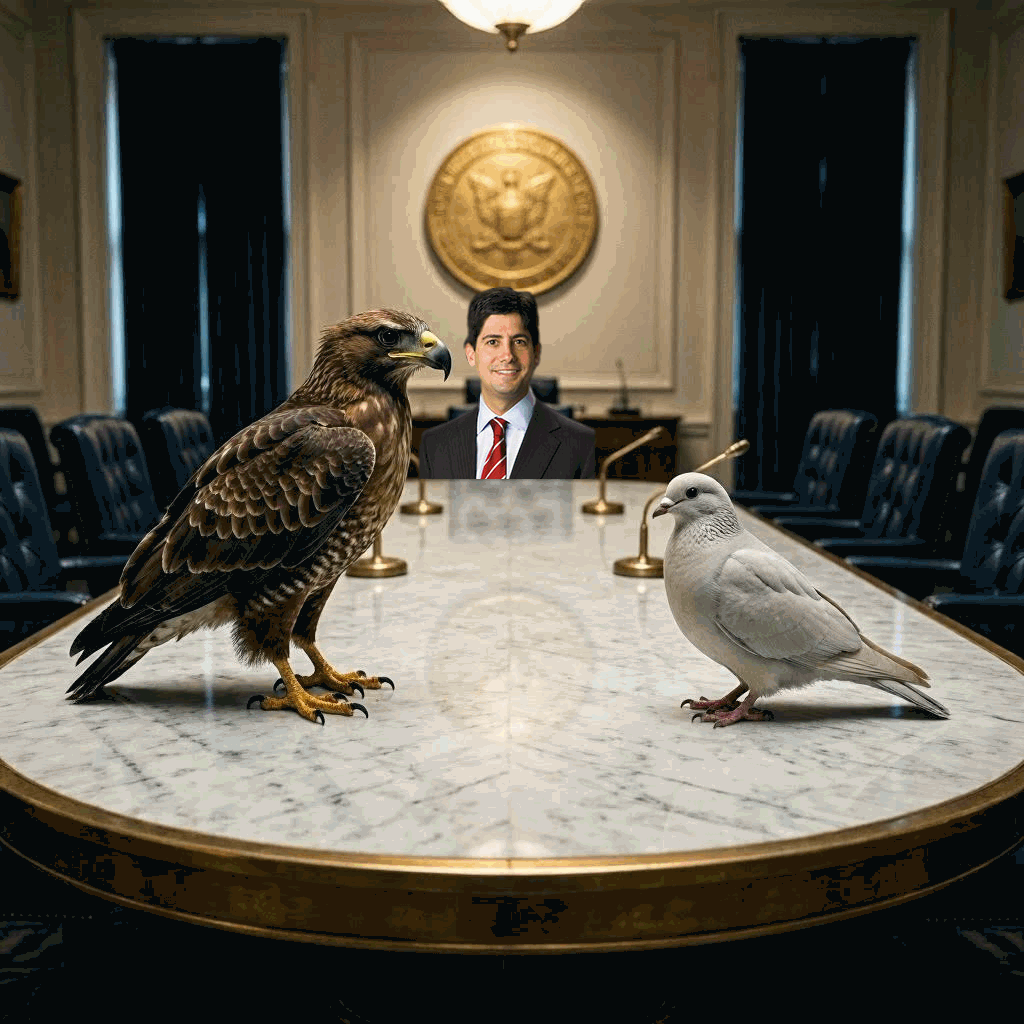 The short answer is: nobody really knows — and that ambiguity is exactly what makes him one of the most fascinating Fed chairs in recent memory.
Kevin Warsh was confirmed as Chairman of the Federal Reserve in May 2026 by a 54-45 Senate vote, taking over from Jerome Powell. On paper, he arrives with a hawkish reputation built over two decades. In practice, he’s been talking like a dove for the past year. And depending on who you ask on Wall Street, he’s either a principled reformer with a nuanced view of monetary policy, or a political weathervane who shifts with whoever is in the White House.
So which is it?
His Track Record: Certified Hawk
Warsh’s hawkish credentials are real and well-documented. During his first stint on the Fed’s Board of Governors (2006–2011), he consistently worried about inflation and pushed back against aggressive monetary easing. When the Fed decided to launch another round of quantitative easing (QE2) in 2011, Warsh actually resigned rather than go along with it.
That’s not the behavior of someone who’s comfortable with an easy money policy.
From 2011 through 2017 Warsh was openly critical of the Fed’s ever-expanding balance sheet, arguing that the central bank had overstepped its mandate and created long-term distortions in financial markets. So, when his name came up as a potential Fed chair in 2017, Wall Street knew exactly what they were getting: someone who thought the post-2008 era of easy money had gone too far.
That reputation put him on Trump’s shortlist in 2017, when the president was looking for someone to replace Janet Yellen as Fed chair. Warsh was interviewed for the role and was widely considered a frontrunner. But Trump ultimately passed on him, choosing Jerome Powell instead. He described Powell as a “consensus builder.” It was a decision Trump would later admit he regretted almost immediately. Powell’s reluctance to cut rates fast enough became a years-long source of friction with the White House, and Warsh’s name kept coming up every time Trump floated the idea of replacing him. This time around, Warsh got the job.
The Recent Pivot: Suddenly Dovish
Here’s where things get interesting. In the lead-up to his nomination, Warsh made a sharp turn. He began publicly advocating for lower interest rates, aligning himself squarely with President Trump’s longstanding preference for cheap money.
Trump has also long held that lower rates make it cheaper for businesses to borrow and expand creating the kind of economic growth that he wants. Trump also wants lower rates to reduce the U.S. government’s enormous debt load. With the national debt north of $36 trillion and Treasury constantly rolling over maturing bonds, even a modest reduction in interest rates saves hundreds of billions in annual interest payments So when Warsh started talking about rate cuts, he was speaking Trump’s language fluently.
But, Warsh’s argument isn’t the traditional Keynesian “juice the economy” case for low rates. Warsh has a more specific theory: he believes AI is fundamentally deflationary. If AI massively increases productivity, the economy can grow faster without generating inflation, which gives the Fed room to cut rates without actually stoking inflation.
This is an interesting but as yet untested thesis. Whether it holds up with inflation above 3% and oil above $100 a barrel, is another question entirely.
The Balance Sheet Twist
Here’s what separates him from a typical dove. Warsh wants lower rates and a significantly smaller Fed balance sheet. Typically those goals are considered incompatable, but Warsh sees them as complementary.
His view is that the Fed’s massive holdings of Treasury bonds and mortgage-backed securities have distorted markets, suppressed risk pricing, and created dependencies that need to be unwound. By shrinking the balance sheet aggressively, the Fed can tighten financial conditions through that channel — which then creates room to cut the policy rate without igniting inflation.
It’s a framework that’s hard to neatly label as either hawkish or dovish. Which is probably why so many analysts are scratching their heads.
The Skeptics: Is This Just Politics?
Not everyone is buying the ideological explanation. Critics point to a pattern that’s hard to ignore: Warsh’s monetary policy views have shifted, repeatedly and conveniently, whenever the political winds change.
Under the Obama administration, he was hawkish as he pushed back against easy money even though the recovery was still fragile. Under Trump’s first term, he pivoted toward lower rates. Then, under Biden, he was back to criticizing the Fed for being too slow fighting inflation. Now that Trump is back in the White House, Warsh is once again aligned with the president’s preference for looser policy.
The cynical read is that Warsh adapted his stated views to make himself the most appealing possible candidate for the chair role. Whether that cynicism is warranted, or whether he genuinely holds a coherent framework that just happens to look different in different macro environments is something the market will be watching closely.
As JPMorgan’s chief U.S. economist Michael Feroli put it: “The two big questions are who’s the real Kevin Warsh and does that evolve?”
What It Means for Rates and Inflation
For investors and everyday Americans watching interest rates, the honest answer is: uncertainty is the baseline.
If the hawkish Warsh shows up, expect a FED that’s genuinely committed to restoring price stability, even if that means holding rates higher for longer than markets want.
If the dovish Warsh shows up expect a Fed that’s more accommodative, with the balance sheet reduction doing the heavy lifting on tightening.
The wildcard is the balance sheet itself. Warsh has made clear he wants to shrink it aggressively. If he follows through on that, it could tighten financial conditions even if the FED Funds rate comes down, giving him a way to satisfy both his hawkish instincts and the White House’s preference for lower rates.
Either way, the Warsh era at the Fed is going to be worth watching.
The Bottom Line
Kevin Warsh is neither a simple hawk nor a simple dove. He’s a pragmatist with strong convictions about Fed overreach, a theory about AI and deflation that may or may not prove out, and a track record of adapting his positions to the economic environment he’s operating in.
What’s clear is that he wants to change how the Fed operates, not just what the fed funds rate is. That means less balance sheet, more focus on the Fed’s core mandate, and a different relationship with Treasury than we’ve seen in the post-pandemic era.
Whether that translates into lower rates, higher rates, or something in between is the question Wall Street will spend the next few years answering.
Read More:
- How will FED Chairman Warsh affect Rates and Inflation?
- Ben Cowan: Is the Fed Heading Toward Checkmate?
- Changes at the Federal Reserve: New Leadership, New Direction
- Will the Collapse of OPEC Result in Lower Oil Prices?
- The California Energy Crisis
- Energy Is Non-Fungible: Costing the World Billions
- FED Monetary Policy
Image Created by Bing.AI
