For the first time since 2018, the U.S. government is shutting down, and investors everywhere are asking the same question: What does this mean for me and the markets?
What exactly is a “Government Shutdown”?
A government shutdown happens when Congress (and the President) can’t agree on a budget or stopgap funding bill. Without that funding, many federal agencies are forced to suspend operations. Essential services will continue like:
-
National security, defense, and law enforcement (e.g. military, FBI, CIA)
-
Air traffic control, border security, TSA screening, and other emergency operations
-
Social Security, Medicare, and Medicaid (since they’re funded via mandatory spending)
-
U.S. Postal Service operations (because USPS is self-financed)
-
Veterans’ medical care and benefits (while many administrative functions may be affected)
-
Some immigration and visa services (because many are fee-funded)
Services likely to be suspended, delayed, or limited:
| Area / Service | What Gets Cut or Delayed |
|---|---|
| National parks, monuments & museums | Visitor centers, interpretive programs, restrooms, campgrounds, trash removal. Some parks may close. |
| New grant programs / funding disbursements | New grants, new program funding, or new project starts may be delayed. |
| Benefit verifications, overpayments, and support services | Processing of overpayment claims, verifications, and some forms of benefit adjustments may pause. |
| Routine regulatory inspections | Health, safety, environmental, workplace inspections may be postponed. |
| New small business loans, program applications, and contract work | Agencies like SBA cannot issue new loans; contract modifications stalled. |
| Passport and consular services (depending on location) | Some passport or visa services may slow or be restricted, especially if hosted in buildings of agencies that are shut down. |
| Education department functions | Investigations, new grants, and advisory services could be cut. |
| Agriculture, rural development, conservation programs | Many USDA rural, conservation, and loan support programs may be paused. |
One important detail for investors: shutdowns also put economic data releases on hold. So the reports Wall Street usually counts on—like jobs data and inflation updates—could be delayed, adding even more uncertainty.
Economic Effects of a Shutdown
The economic ripple effects are big. Between 750,000 and 800,000 federal employees could be furloughed without pay until an agreement is reached. The result is the exact opposite of the stimulus checks we saw during COVID, i.e., less spending as these employees cut back on personal spending to weather the storm.
According to the Federal Reserve, the Federal Government’s spending was roughly 23% of the total GDP in 2024 (down from over 30% during COVID). Of course, not all of that spending will be cut, but the hit to the economy is still estimated to be $200–$400 million per day.
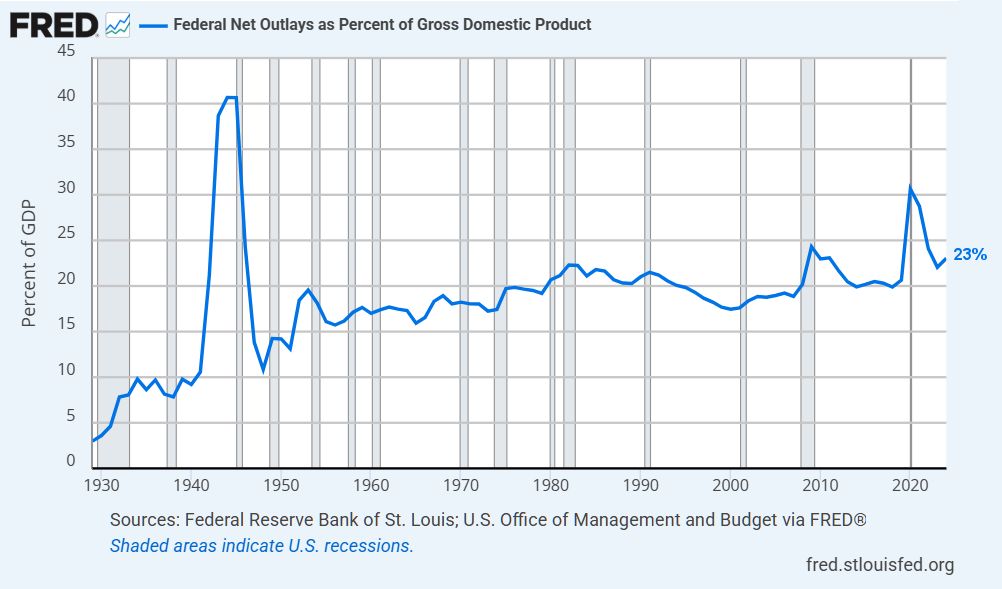
Source: FRED
Naturally, this uncertainty causes market concerns during the shutdown. But here’s the silver lining: history shows shutdown-related selloffs rarely last. In fact, they’ve often been followed by strong rebounds. Take the record-long shutdown of 2018–19: while it dragged on for 35 days, the S&P 500 bottomed just before it began—and then went on to rally more than 25% once the dust settled.
The lesson? Shutdowns may feel unsettling in the moment, but markets have a long track record of shaking them off once clarity returns.
Summary:
The U.S. government is shutting down for the first time since 2018, suspending many non-essential services while essential operations (military, Social Security, Medicare, USPS, TSA, etc.) continue. Around 750k–800k federal employees will be furloughed, cutting consumer spending and costing the economy an estimated $200–$400 million per day. For investors, shutdowns delay key economic data releases and create short-term uncertainty, but history shows market sell-offs are typically brief and often followed by rebounds.
