Institutional investors, ETFs, and lower volatility are changing how Bitcoin’s price moves.
For many years, Bitcoin’s price followed a clear pattern tied to an event called the “halving.” About every four years, the number of new bitcoins created is cut in half. In Bitcoin’s early days, this had a huge effect on price. Fewer new coins meant scarcity, and prices often rose fast after each halving.
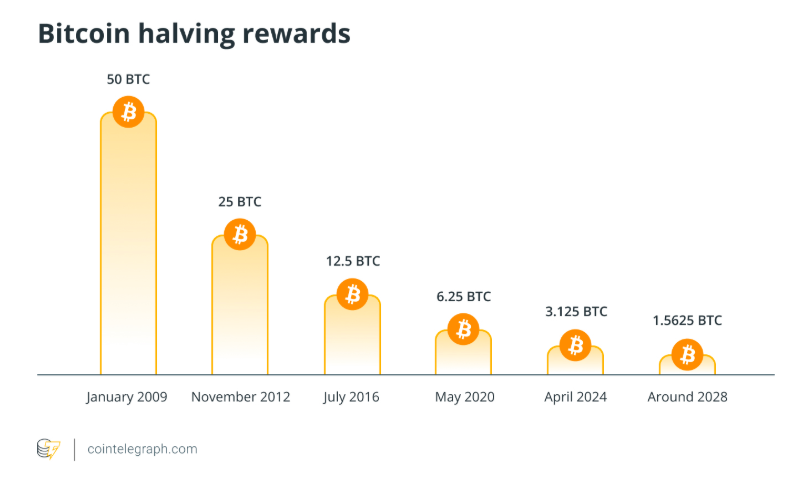
Today, that pattern is weakening. Most bitcoins are already in circulation, so each new halving removes a smaller amount of supply than before. Because of that, halvings no longer cause the kind of explosive price jumps seen in the past. The following chart, in Log scale, clearly shows percentage gains.
In the chart, we can see that after the first halving in 2009, Bitcoin went from 5 cents in 2010 to $32 in 2011, an unbelievable percentage gain. But then it fell to $2. this, of course, discouraged many buyers who bought at higher prices. But in hindsight, even buying at the peak of this cycle would be a massive bargain today.
Following the next halving in 2012, BTC rose from $12 to $1,220, another unbelievable percentage gain, before falling to $162. After the 2016 halving, it rose from $475 to $20,000 and then fell to roughly $3,100.
And after the 2020 halving, it rose from around $9,000 to over $65,000. Not nearly the percentage gains of earlier halvings, but still a 7x. Then, once again, BTC lost a good portion of its gains to around $15,000. Note that BTC never returned to previous lows, and always gradually rose before the next halving.
After the most recent halving in 2024, it rose from around $50,000 to over $100,000, fell to $77,000, rose to over $125,000, and then fell to around $80,000. So, in percentage terms, volatility has greatly reduced, to values more in line with traditional finance. 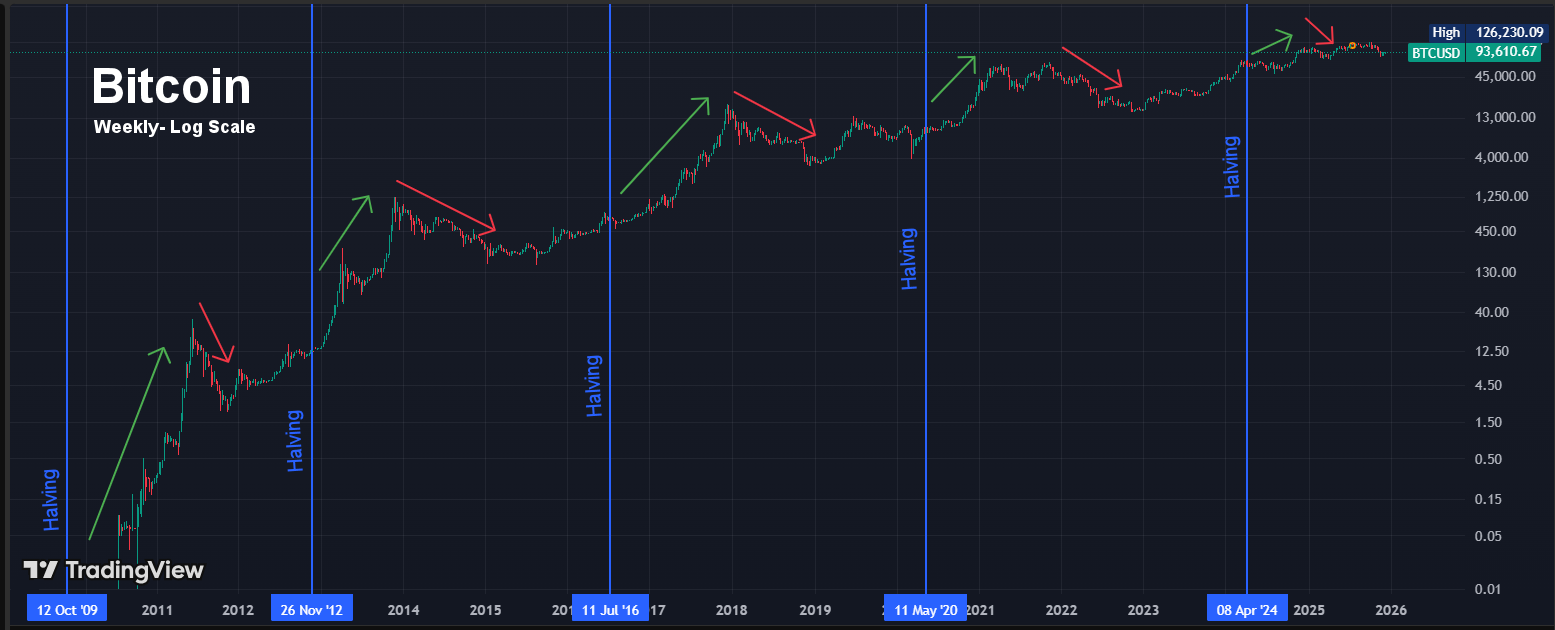
Note: The above chart was created using TradingView. It lets you access powerful charting tools, real-time market data, and a global community of traders—all on one intuitive platform. Create your own free TradingView account.
BTC Volatility
Bitcoin prices still move up and down, but not as wildly as before. According to Grayscale, the Bitcoin market today is very different from earlier years. In the past, retail investors—regular people trading on apps and exchanges—drove huge price swings. Now, large institutions play a much bigger role.
This difference shows up when comparing old and new market cycles. In 2013 and 2017, Bitcoin prices shot straight up and then crashed hard. Those rallies were mostly fueled by excited retail traders rushing in. After the peaks, prices fell sharply and stayed low for long periods. Even in 2021, many price gains were still pushed by individual investors.
Recent price action looks calmer. Instead of a sudden spike, Bitcoin has risen in a more steady way. When prices later dropped about 30%, Grayscale described this as normal for a strong market, not a sign of a major crash. In stock markets, these kinds of pullbacks happen often during long-term uptrends.
Today, Bitcoin reacts more to big-picture forces. Interest rate expectations, progress toward clear US crypto laws, and the launch of Bitcoin exchange-traded funds (ETFs) all influence prices. Many pensions, funds, and companies now hold Bitcoin as part of their investments. This means prices move more like traditional financial assets.
Still, some experts believe the halving is very important. They argue that it always reduces supply and cannot be ignored. Data from companies like Glassnode show that long-term investors tend to buy and hold around halving periods. Others say retail traders may return in large numbers during future rallies, even with institutions involved.
These different opinions show that Bitcoin is still changing. The four-year halving cycle may not control prices the way it once did, but it still plays a role. Bitcoin is no longer just a retail-driven experiment—it is becoming a mature financial asset shaped by many forces at once.
The Best Place to Buy Your Crypto
Coinbase is the largest Crypto Trading platform in the U.S. and the easiest to use.
Check out Coinbase here.
Summary:
Bitcoin doesn’t move the way it used to. Bitcoin’s famous halving cycle is losing its grip on prices as institutional investors, ETFs, and lower volatility reshape the market.
You might also like: