Capacitors, AI, and Crypto – Oh My
 Back in the 1980s, shortly after graduating from college, I briefly worked as an energy consultant. At that time, energy prices were skyrocketing and companies were feeling the pinch. So, as a consultant, I would help them find ways to reduce energy usage without adversely impacting output.
One of the companies I visited was getting a huge surcharge for something called “power factor”. A “lagging power factor” is caused by motors, transformers, and things like fluorescent lights, all components of this 1980s factory. And in those days, there were lots of factories. This caused strain on the grid, so utilities would charge companies a penalty if they had a lagging power factor.
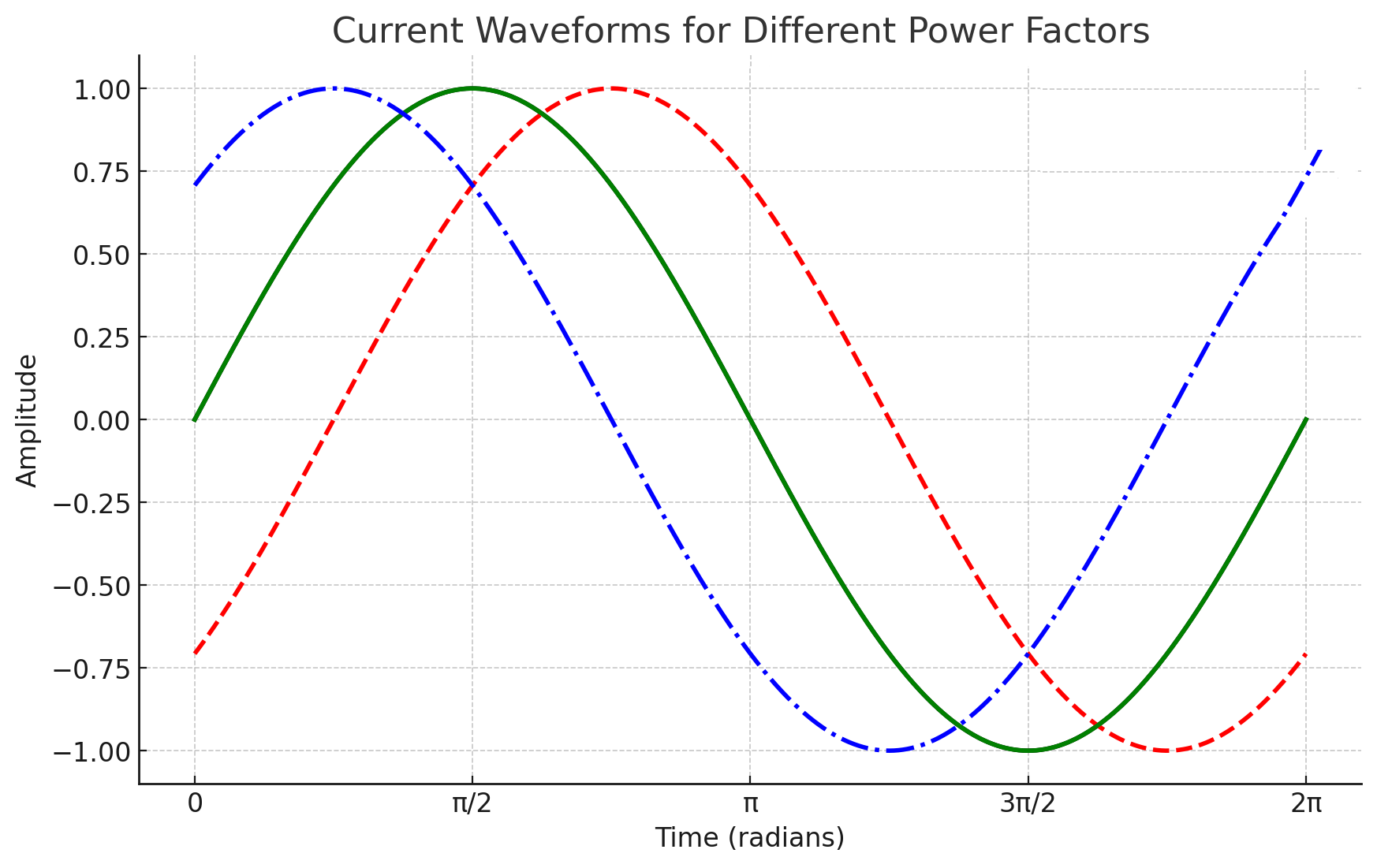
In the following chart, we can see a representation of different power factors. The green wave is what the utility is trying to generate, but if you throw their wave out of sync, they aren’t happy.
To correct a lagging power factor, factories would install large capacitors.
Then along came computers… lots of computers… and inside a computer’s power supply are a bunch of capacitors… fewer factories and more computers and voilà, no more lagging power factor problem.
New Problems Today
Unfortunately, AI is creating its own set of electrical problems. It not only consumes a significant amount of electricity, but demand can fluctuate substantially from one millisecond to the next. A millisecond drop of demand doesn’t sound all that serious, but that excess electricity has to go somewhere (just like lightning), and that can be disastrous. And that somewhere has to be able to absorb that excess instantaneously, so companies like Tesla are developing the equivalent of modern-day capacitors to handle that problem.
Another modern-day problem is actually excess capacity. In electricity generation, as in economics, supply has to equal demand. Utilities are constantly matching their production to the demand (i.e., load).
As we covered in The Truth About AI and Electricity Capacity, matching production to load can be challenging. Renewables like solar and wind produce power when they want to, not necessarily when it is needed. Nuclear power, on the other hand, has to be produced constantly, whether it is needed or not; hydroelectric power varies with water availability, and only natural gas can be reliably varied based on projected demand (but not instantaneously).
What if Too Much Electricity is Produced?
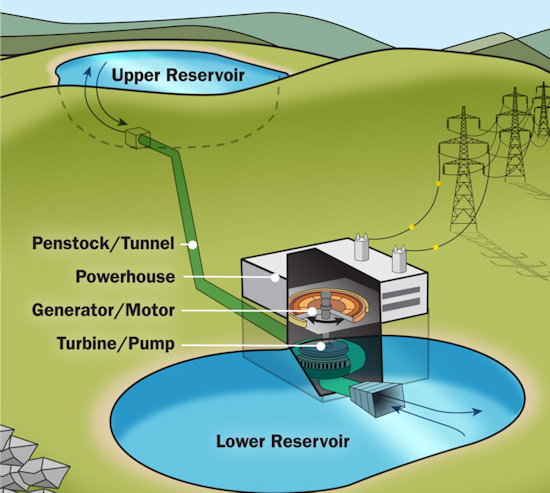
Excess electricity has to be “dumped” (for instance, on sunny days in places with lots of Solar farms). This can be done by charging batteries, or it can be shunted to heat water, create ice, or produce hydrogen via electrolysis. It can also be used to pump water uphill into reservoirs, which can later be released through turbines to generate electricity when demand rises. As a last resort, excess electricity is ‘dumped” by generating heat that is just wasted.
Note: Back in the early 1970s, my best friend’s father worked on the Blenheim-Gilboa Power Project in Upstate New York that pumps water uphill during surplus power to work as a giant grid-scale battery.
Crypto to the Rescue
You might wonder how crypto can possibly factor into this equation. Like AI, Crypto is another major electricity consumer, but unlike AI, Crypto (especially Bitcoin) is “mined” through steady plugging away at a complex calculation. So, Bitcoin mining doesn’t suffer from those millisecond power blips. And demand can be adjusted to match supply, so when there is excess electric supply being created, this “free electricity” can be diverted to producing bitcoin, and using free electricity to create “money” helps with the “bottom line”. When supply is lacking, bitcoin production can be cut back or even eliminated. For instance, in December 2022, Winter Storm “Elliott” crippled Texas electricity production, and within minutes, Bitcoin miners were able to slash enough power for 300,000 homes (1.5+ gigawatts GW), to help stabilize the state’s grid.1
Countries Currently Using Crypto Mining to Balance Electricity Grids
Several countries are currently using this approach to siphon off excess production.
1. United States- Texas grid operator (ERCOT) uses large cryptocurrency mining operations as highly flexible “controllable loads.” Miners ramp up usage when there’s surplus energy (e.g., from renewables) and reduce it during peak demand.2
2. Germany-Bitcoin mining is being integrated as a flexible demand-side mechanism to absorb surplus from wind/solar and support renewable grid stability.3
3. Finland- In 2023, Finland completed its “Olkiluoto-3” 1.6 gigawatt nuclear reactor after decades in the making. Combined with Finland’s massive wind sector, it has resulted in a grid that often produces more energy than needed. In 2023 alone, Finland had more than 800 hours of negative electricity prices.
In addition to using massive amounts of electricity, crypto mining generates lots of heat from cooling all those CPUs. So, Finland is using excess electricity to mine Bitcoin, and using the excess heat generated by the CPUs to heat houses by pumping 70ºC (158ºF) water into the existing municipal hot water system.
4. Austria- Projects in Austria are converting surplus hydroelectric energy into mining operations.
5. Pakistan- Allocated ~2,000 MW of electricity capacity specifically for crypto mining and AI data centers.
6. Uganda- The country’s abundant hydropower has created surplus capacity (over 1 GW). Bitcoin mining is seen as a means to monetize this surplus, attract investment, and support infrastructure.
7. El Salvador- Uses geothermal power (from volcanoes) for Bitcoin mining, turning excess energy into both crypto and useful byproducts such as heat for algae farms.
8. Paraguay- Benefits from a massive surplus from the Itaipu hydroelectric dam. Bitcoin mining helps absorb the surplus, generating substantial economic value.
9. Norway- Hydropower-rich Norway uses incentives/subsidies to encourage mining with surplus energy, effectively turning unused capacity into economic gain.4
10. Bhutan- Bhutan has entered into a partnership with Bitfury, a leading Bitcoin mining company, to leverage its abundant hydroelectric power resources for Bitcoin mining. This initiative aims to diversify Bhutan’s economy while optimizing the use of sustainable energy.
11. Russia- In Norilsk, above the Arctic Circle, Russian firm Bitcluster is mining Bitcoin using ultra-cheap electricity, from local natural gas and hydropower. The frigid climate naturally cools mining rigs, slashing energy costs and extending hardware lifespan. Housed in repurposed containers at a former nickel plant, the operation leverages Norilsk’s isolated energy grid for high-efficiency, low-maintenance Bitcoin production.
Countries Considering Using Crypto Mining to Absorb Excess Production
1. France- France, generates over 70% of its electricity from nuclear power. Often, this results in overproduction. In 2024 alone, nearly €80 million worth of electricity went unused. Lawmakers in France have proposed using Bitcoin mining to absorb this surplus.
2. Belarus: Studies are underway on using Bitcoin mining similarly.
3. South Korea: A May 2025 academic study finds repurposing surplus electricity for Bitcoin mining could help Korea Electric Power Corporation (KEPCO) manage debt and reduce energy waste.
4. Kazakhstan- Exploring mining powered by methane captured from coal mines. This repurposes harmful GHG emissions and turns them into energy for mining.
Conclusion:
At one time, a negative “power factor” was causing grid problems, then it shifted to a positive “power factor” problem, and now the problem is millisecond AI glitches and surplus power. And Crypto is providing an unusual solution.
References: