
 Key Points:
- BTC topped on October 5, 2025.
- Matt Hougan suggests crypto winter started earlier.
- Institutional money may have skewed the cycle.
- Our editor believes that the cycle is still on track.
- Legendary investor W.D. Gann emphasized both “Time and Price”.
The current consensus seems to be that late 2025 was BTC’s cycle peak, when social media was flooded with “$200K BTC incoming” posts and Bitcoin’s all-time high topped out at about $126,198 on October 5, 2025. But Matt Hougan, Chief Investment Officer at Bitwise Asset Management, argues the real downturn actually began much earlier — in January 2025 — and most people simply didn’t notice.
Hougan’s core idea is simple: the bear market started quietly, beneath the surface.
Institutional Money Masked Early Weakness
According to Hougan, broad crypto weakness was already showing up in early 2025, especially among altcoins and retail-heavy assets. But massive institutional inflows — driven largely by newly approved Bitcoin ETFs and digital asset treasury allocations — temporarily propped up Bitcoin and Ethereum.
So while headlines were screaming about ETF demand and BTC strength, much of the rest of the market was already rolling over. Hougan describes this period as having two timelines: one for the institutions and one for retail investors.
Did a Split Market Emerge?
Retail-focused tokens started dropping as early as January 2025, signaling stress across the ecosystem. Meanwhile, institution-friendly assets stayed elevated thanks to steady inflows. This made it feel like the bull market was still alive, even though a broader contraction was already underway.
If you looked beyond Bitcoin and Ethereum, the signs were hard to ignore: shrinking liquidity, falling altcoin valuations, and weakening activity across DeFi and speculative sectors.
Price Action and the Shift
Another part of Hougan’s thesis is simple price behavior. While BTC and ETH held up for a while, many tokens experienced sustained drawdowns much earlier in 2025. That kind of broad underperformance usually marks the start of a crypto winter — not just a temporary pullback.
In other words, this wasn’t a quick dip. It was a structural change.
Sentiment Never Truly Recovered
Despite positive developments like institutional adoption and regulatory progress, market sentiment stayed weak throughout 2025. Fear indicators remained elevated, rallies kept getting sold, and confidence never fully returned — all classic bear-market behavior.
People were already trading defensively, even if they didn’t realize it yet.
Crypto History Timeline
Hougan compares this cycle to past crypto winters in 2018 and 2022, both of which lasted roughly 12–13 months from peak to trough. If January 2025 is treated as the real starting point, puts the end point within reach.
Waiting until late 2025 to declare the bear market, puts the end around October 2026.
Risks Contrasted
The risk of believing in an early end is that you get caught believing you are buying the dips only to discover further downside awaits. Conversely, expecting an October end could cause you to wait too long and miss buying opportunities. A compromise approach for long-term BTC bulls, would be to “Dollar Cost Average” between now and October, or simply to buy the dips during that period, not worrying about price declines until after October.
The Big Takeaway
Hougan’s message is straightforward: crypto entered a bear market in January 2025 — it just didn’t feel like it at the time.
Institutional buying delayed the obvious pain, but beneath the surface, retail assets were already collapsing, sentiment was deteriorating, and the market structure had shifted.
For retail investors, the lesson is clear: don’t just watch headline prices. Real market turns usually start quietly — long before everyone agrees they’ve arrived.
Another factor investors should keep in mind is the rise of what many call “paper Bitcoin.” With institutions now accessing BTC through ETFs and custodial products, a growing portion of Bitcoin exposure exists only on balance sheets — not on-chain. While these vehicles make crypto easier to buy, they also introduce synthetic supply, where multiple claims can effectively exist on the same underlying coins. Over time, this could dilute Bitcoin’s scarcity narrative and dampen upside during bull cycles, while potentially increasing downside volatility during sell-offs. For long-term holders, this strengthens the case for understanding where your Bitcoin actually lives — and why self-custody still matters.
What This Means for Investors Now
If Hougan is right, the most important takeaway isn’t about calling tops — it’s about understanding market structure. Crypto bear markets don’t start with panic. They start with quiet weakness, fading momentum, and altcoins rolling over while Bitcoin still looks “fine.”
For retail investors, that means paying attention to what’s happening under the hood, not just headline BTC prices. Broad market participation, liquidity, and altcoin strength often tell the real story long before the charts make it obvious.
It also reinforces the importance of risk management. In bear markets, capital preservation matters more than chasing rebounds. This is typically the phase where patience, selective buying, and longer-term positioning outperform aggressive trading.
Historically, crypto winters eventually create the best opportunities — but only for investors who stay disciplined, avoid overexposure, and keep dry powder available. The real money is rarely made during the hype phase. It’s made quietly, when sentiment is low, and everyone else has already checked out.
Editor’s Note:
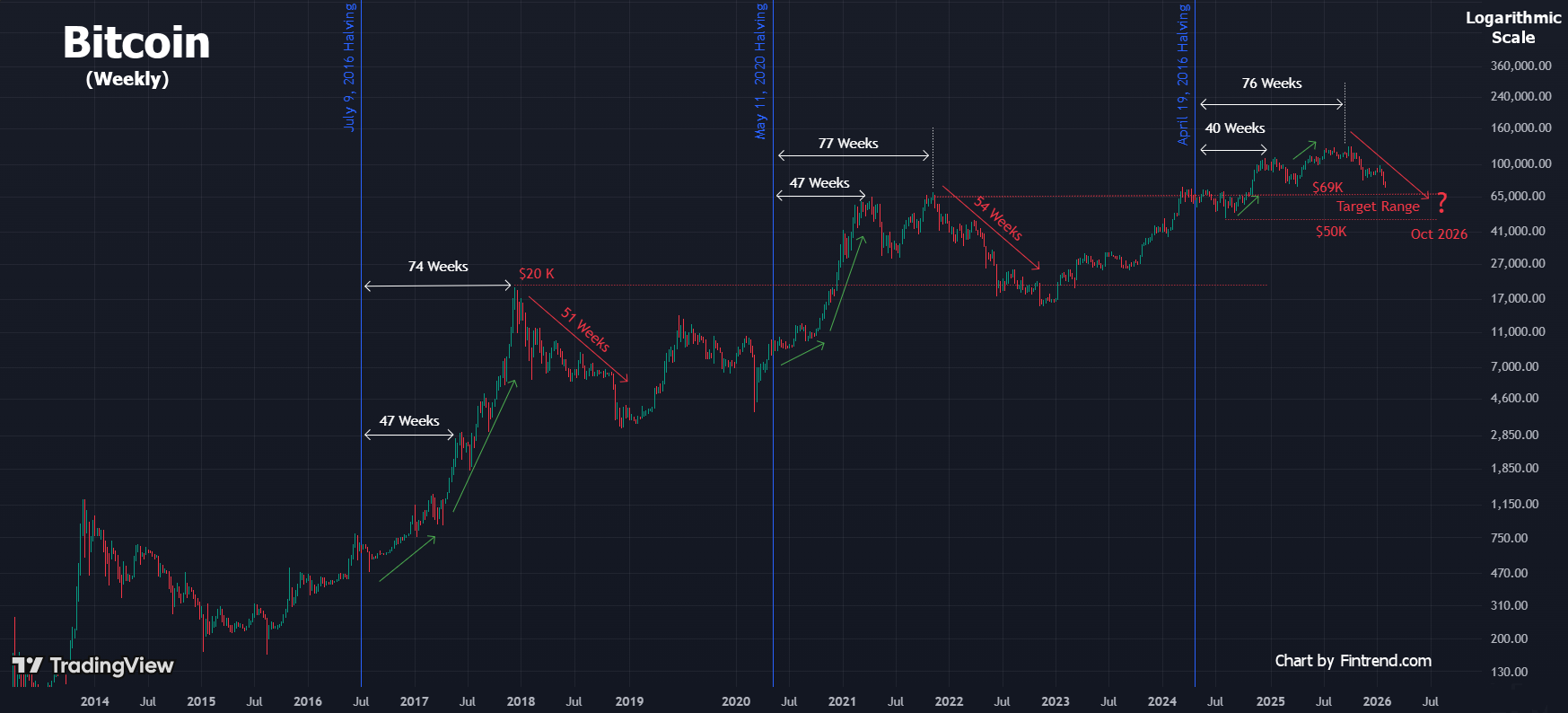
Personally, I think Hougan is overthinking it or letting his overt bullishness cloud his thinking. As I said in my Crypto ROC analysis, I believe Bitcoin is right on its 4-year schedule. As far as his argument that massive institutional inflows via newly approved Bitcoin ETFs temporarily propped up Bitcoin and Ethereum… I think that was just the current iteration of the final leg of euphoria. Every cycle is just enough different to fool the masses into thinking “this time is different,” but the destination is really the same, just a different route to get there.
Regarding Hougan’s argument that there was no “Alt-season,” I’d say, there were so many alternatives that the money was there, just spread thinner.
I do believe that institutional investment skewed the market, short-selling dampened the typical mania top, and gold stole some of BTC’s euphoria. But I don’t think we can count on an early end to this iteration of Crypto-winter. However, it does look like we are heading toward my target range of $50k-$69k quicker than usual. This could mean a longer consolidation in that range until the time component runs out. Here is the chart of my analysis of the BTC Cycle as presented on the Crypto ROC page. Be sure to check out the full article.
Legendary investor W.D. Gann said:
- “Time is more important than price. When time is up, price will reverse.”
- “Price can lie, but time never does,”
- “The past repeats itself in exact cycles. Time is the key factor.”
- “There is a definite mathematical relationship between price and time.”
- “Time is the great retracer; when time is up, price changes.”
So, if Gann is right, this cycle won’t end early. Gann saw markets as cyclical, with recurring time intervals driving reversals. Price is secondary; knowing when a cycle ends allows you to anticipate the move. Gann emphasized that price and time are linked — a move in price is often matched by a corresponding time cycle. Understanding this relationship is central to his market predictions. According to Gann, markets follow geometric and numerical laws. Charting price without considering time is incomplete; the two are inseparable.
W.D. Gann applied to Crypto:
These principles suggest that looking at Bitcoin or altcoin cycles purely through price may be misleading. Instead, understanding the timing of historical peaks, halvings, or institutional inflows can help anticipate major reversals.
See Also:
- Crypto ROC analysis
- NYSE ROC Analysis
- NASDAQ ROC Analysis
- Gold vs Oil Chart
- Bitwise CIO Warns Market Is Facing A ‘Full-Bore’ Crypto Winter, Not A Pullback