Understanding Why Electricity Can’t Be Freely Moved Across Time and Space—And What That Means for Global Efficiency
 Here’s a Question Nobody Is Asking
If energy is energy, why can’t we just move it around wherever it’s needed? Why do some regions have excess power while others face scarcity? Why do we curtail renewable generation during peak production hours?
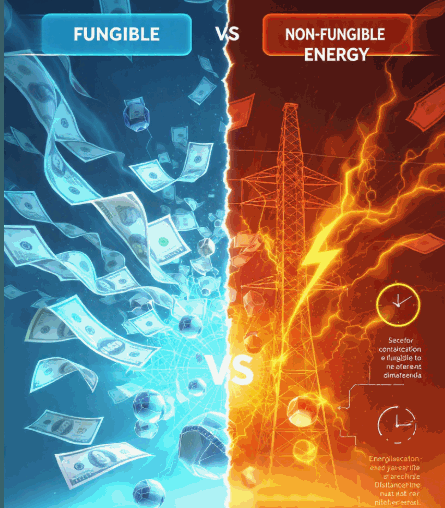
The answer lies in one fundamental economic principle that energy markets have largely ignored: energy is not fungible.
This single insight, explained clearly by analyst Lyn Alden in a recent podcast, reshapes how we should think about global electricity infrastructure, renewable integration, and energy efficiency. And it reveals a crisis that nobody’s really talking about: the world wastes staggering amounts of electricity every single day.
Let’s understand the physics first, the waste second, and then explore some surprising solutions.
What Makes Something Fungible? And Why Energy Isn’t
In economics, fungible means interchangeable. A dollar is fungible… your $100 bill has identical value to my $100 bill. Oil is slightly fungible… a barrel of crude from Texas has similar properties to a barrel from Saudi Arabia, but different viscosity and sulfur content. So, they require different processing, and individual refineries specialize in different grades of oil. However, once refined gasoline is once again very fungible.
Energy, however, is a completely different animal.
Electricity has three fundamental constraints that make it radically non-fungible:
Fungibility Constraint #1: Time
Electricity cannot be stored in large, efficient quantities. A battery system can store some energy, but the losses are significant, the cost is high, and the capacity is limited. A 100-megawatt lithium battery system might cost $50-100 million. Scale that to grid-level storage for a whole region? Economically impractical. Other storage solutions, like pumped-storage hydroelectricity, are impractical in flat regions, arid areas with limited water, or places lacking stable rock formations.
They also have high up-front costs, take 5+ years to build, and have financing challenges due to long lead times, regulatory uncertainty, and market risks. They also have efficiency issues. Typical real-world round-trip efficiency is about 70–80%.
There are also environmental concerns, including habitat disruption, evaporation losses, water quality disruptions, etc.
Practically speaking, this means electricity needs to be generated at the exact moment it’s consumed. It is truly a use it or lose it situation.
Fungibility Constraint #2: Space
Transmitting electricity across long distances is expensive and lossy. High-voltage transmission lines lose energy to heat resistance. The longer the distance, the greater the loss. Building new transmission infrastructure costs billions and takes a decade of permitting and construction. It’s not like piping oil, where infrastructure is built once and lasts for decades.
Fungibility Constraint #3: Generation Variability
Power plants of different types have different operating profiles. A coal plant takes hours to ramp up. A natural gas plant can adjust within minutes. A nuclear plant runs best at constant output. Solar and wind generation is unpredictable and location-dependent. You can’t simply choose to generate more power where it’s needed—generation happens where the resources are (sun, wind, coal reserves, rivers).
Together, these constraints create a harsh reality: electricity generated in one place at one time cannot be freely substituted for electricity in another place at another time.
This is what makes Electricity fundamentally non-fungible. But what about Natural Gas?
If an oil well strikes a small pocket of natural gas, it is uneconomical to build a pipeline just to capture that gas, so what do they do? They either just vent it into the atmosphere (which is actually more harmful to the environment than CO2 or they set it on fire, converting the waste to slightly less harmful CO2 .
And as mentioned previously, even oil is not 100% fungible.
The Waste Crisis: Orders of Magnitude Larger Than Most Realize
Once you understand that energy is non-fungible, you can’t ignore the obvious question: what happens to all the electricity that’s generated but not needed?
The answer is disturbing. Enormous amounts of electricity are wasted every single day.
Curtailment: Wasting Solar Energy
As renewable energy penetration increases globally, curtailment is becoming a massive problem. Here’s how it works:
When solar generation exceeds what the grid can safely absorb (due to low demand, transmission limits, or minimum operating levels of other plants), grid operators deliberately reduce output from solar farms.
- This is called curtailment — essentially “switching off” or throttling down solar inverters.
- It happens most often in spring and fall in high-solar regions like California (CAISO), when mild weather keeps demand low, but skies are clear.
- Curtailment protects grid stability (frequency, voltage) but wastes clean energy and reduces revenue for solar owners.
This happens not because of technical incompetence but because of the non-fungible nature of electricity. The power exists, but can’t be used in that moment.
In regions with high renewable penetration, curtailment rates are climbing. Germany, California, and other areas with aggressive solar/wind deployment are increasingly having to waste generation during peak hours. It’s economically rational but environmentally perverse: we’re literally turning off clean energy because we can’t use it right now or move it elsewhere fast enough.
The Flaring Crisis: Eight Times Larger Than You Think
But solar curtailment is just the tip of the iceberg. As mentioned above, there’s another, even larger waste problem: natural gas flaring. To put the problem in perspective, Bitcoin often gets maligned as a huge energy waster, but no one talks about flaring. According to the World Bank’s most recent estimates, the amount of natural gas being flared globally is approximately eight times the total energy consumption of the entire Bitcoin network.
Let that sink in. Eight times, but somehow, Bitcoin is the problem.
This isn’t a marginal inefficiency. This is a global crisis hidden in plain sight. Billions of BTUs of usable energy are destroyed annually simply because it’s located where there’s no infrastructure to use it.
The Transmission Loss Problem
Beyond curtailment and flaring, there’s the steady drain of transmission losses. Every time electricity moves across a power line, some is lost as heat. Over long distances, these losses can be 5-10% or more.
Globally, this means roughly 100+ terawatt-hours of electricity—equivalent to the annual consumption of many developed nations—is lost just to transmission inefficiency. That energy is generated, transmitted, and literally radiated away as heat.
The Excess Capacity Problem
Electricity grids must be overbuilt to handle peak demand, even if peak demand only occurs for a few hours per year. A power plant might run at 40% capacity most of the time, existing primarily to handle the few days per year when demand spikes (extreme heat waves, cold snaps). That stranded capacity represents wasted infrastructure investment and efficiency.
Add it all together—curtailment, flaring, transmission losses, excess capacity—and the scope of global energy waste becomes staggering.
A very large percentage of the electricity generated globally is being wasted. And unlike traditional waste, this waste is structurally baked into how energy works.
Why Energy Markets Ignore the Non-Fungible Reality
The energy industry operates on market assumptions that don’t match physical reality. The traditional model assumes:
- Energy can be moved where it’s needed (it can’t, efficiently)
- Energy can be stored affordably (it can’t, at scale)
- Supply can respond immediately to demand (it can’t, for most generation types)
- Generation can be located anywhere (it can’t, it depends on resources)
These assumptions work fine when energy demand is relatively stable and predictable. But as we add more renewable energy (which is variable and location-dependent), as electricity demand grows (EVs, heat pumps, electrification), and as transmission constraints tighten, the non-fungible reality becomes impossible to ignore.
The market needs ways to capture and use stranded energy. But the traditional mechanisms—building more transmission, investing in storage, optimizing grid dispatch—are slow, expensive, and incomplete.
Solutions: Matching Demand to Stranded Energy
If energy is non-fungible, the solution isn’t to pretend it is. Instead, we need to be smarter about how we use stranded energy. Unfortunately, AI is not helping but actually making the problem worse. AI requires electricity to be available instantly (in microseconds) whenever a surge in processing power is needed. So, this can stress the grid because it must always have excess capacity available to cover these surges in demand. Some grid operators are requiring the AI centers to cover these surges themselves through battery storage.
Solution One: Demand Flexibility
The most obvious approach is to move demand to match supply—rather than the reverse.
This is already happening: data centers are being located near hydroelectric dams. Industrial processes that require heat are being placed near geothermal or excess thermal capacity. Electric vehicle charging is being concentrated during periods of excess renewable generation.
Companies and industries with flexible demand profiles can collocate with stranded energy and operate when power is cheap. This is economically rational and reduces overall waste.
The challenge: most electricity demand is inflexible. People need power at specific times (morning showers, evening meals, overnight heating). You can’t simply move residential demand to 2 PM on a sunny Tuesday. However, States like California have instituted time-of-day “dynamic” pricing, which creates economic incentives to encourage residents to shift electric usage to when demand is lower.
Solution Two: Energy Storage and Conversion
Battery technology, hydrogen production, and thermal storage can convert stranded electricity into storable forms. Excess solar power can charge batteries or produce hydrogen, pump water to higher locations, or lift weights in “gravity batteries“. That stored energy is then available when needed.
The problem: storage solutions are still expensive at “grid scale”. A lithium battery costs roughly $100-150/kWh. For a region to store enough energy to balance a full day of renewable variability would cost tens of billions of dollars.
Storage is part of the solution, but it’s not sufficient on its own.
Solution Three: Industrial Loads at Stranded Energy Sites
A more practical near-term solution is to identify industrial processes that can operate profitably with free or near-free electricity and locate them where stranded energy exists.
For remote natural gas deposits: instead of flaring the gas, operate industrial processes that consume it. You eliminate waste, create economic activity, and develop previously uneconomic resources.
For renewable-heavy regions during peak generation, operate energy-intensive industries during these periods. When demand is high elsewhere, shut down.
This approach requires:
- Identifying which industrial processes can be flexible
- Building infrastructure in remote locations
- Creating markets for stranded energy
Several industries are already doing this. Aluminum smelters have historically been located near cheap power sources. Now, entrepreneurs are developing new uses for stranded resources.
Solution Four: Converting Stranded Energy Into Digital Assets
One unconventional but increasingly relevant solution is to convert stranded electrical energy into digital assets of value—something perfectly fungible and portable.
This is where Bitcoin mining enters the picture.
Bitcoin Mining: One Solution to a Much Larger Problem
If you’ve spent any time in crypto discussions, you’ve probably heard someone say something like: “Bitcoin uses too much energy! Think about all the hospitals that could be powered instead”. But understanding it as a solution to stranded energy reframes the conversation entirely.
Bitcoin mining operates under intense economic pressure. Miners compete globally on a narrow margin: the cost of electricity versus the value of newly mined coins. A miner with expensive electricity goes bankrupt. A miner with cheap electricity survives.
This creates a singular economic incentive: find the cheapest electricity in the world.
And where is the cheapest electricity? Overwhelmingly, it’s stranded energy—electricity that would otherwise be wasted.
During peak renewable generation hours, when electricity prices drop to zero or go negative, cryptocurrency miners operate at maximum capacity. When demand spikes and electricity gets expensive, unlike AI they can shut down. This flexibility makes them valuable to grids by absorbing excess capacity during low-demand periods.
For stranded natural gas in remote areas, miners can relocate operations to oil and gas sites. Instead of flaring the gas, it powers mining operations. The operation extracts economic value from a resource that would otherwise be destroyed.
Top Countries Using Surplus Electricity for BTC Mining
| Country | Main Surplus Source | Details | Status (2025–2026) |
|---|---|---|---|
| Paraguay | Hydropower (Itaipú Dam) | One of the world’s largest hydro surpluses; a significant hashrate share. | Major player, ~3.5% global hashrate |
| Bhutan | Hydropower | Government-backed mining using abundant clean hydro to build sovereign Bitcoin reserves. | Strong state involvement |
| Ethiopia | Hydropower (Grand Renaissance Dam) | Foreign companies run large farms on cheap surplus hydro; helps earn foreign currency. | Fast-growing, potentially high consumption |
| Iceland | Geothermal + Hydropower | Historically used surplus renewable power; cool climate helps cooling. Surplus is now tightening. | Established but smaller share now |
| Canada | Hydropower (Quebec, British Columbia) | Provinces with hydro surpluses attract miners. | Significant operations |
| Brazil | Hydropower + growing Wind/Solar | Surplus from renewables (wind/solar outpacing grid in some areas); companies exploring mining to monetize excess. | Emerging hub |
| Pakistan | General power surplus | The government plans to allocate hundreds of MW of surplus electricity to BTC mining and AI data centers. | Policy-driven push |
| Laos | Hydropower | Using excess hydro to generate revenue and ease debt. | Active exploration |
| France | Nuclear power | Considering/eyeing surplus nuclear output for mining + waste heat reuse. | Policy discussions |
| United States (Texas) | Wind (and some Solar) | Miners buy or own wind farms to use curtailed/negative-price power; flexible load helps grid stability. | Very large; behind-the-meter mining common |
Note: Bitcoin mining using surplus electricity helps monetize otherwise curtailed or low-value power, especially from hydro, wind, and solar sources.
The Real Takeaway: Energy Policy Must Acknowledge Physical Reality
The core insight from understanding energy’s non-fungible nature is this: the energy system has structural inefficiencies that can’t be solved by traditional means.
You can’t move stranded electricity to where it’s needed (transmission is too expensive). You can’t store it affordably at scale (storage is too costly). You can’t magically generate it elsewhere (it depends on physical resources and location).
So the only viable solution is to move demand to the stranded supply.
This means:
- Locating data centers near cheap, abundant power sources
- Building industry in regions with stranded energy
- Creating markets for flexible industrial loads
- Developing new uses for resources that are currently wasted
- Supporting technologies that can operate anywhere and respond dynamically to price signals
None of this requires embracing cryptocurrency. But it does require acknowledging that energy is non-fungible and designing policy and infrastructure accordingly.
The world wastes staggering amounts of electricity every day. Some of that waste is unavoidable—transmission losses, the need for grid redundancy. But much of it is avoidable if we stop assuming we can move energy freely and instead accept the physical reality of how electricity works.
Understanding that energy is non-fungible isn’t just an academic point. It’s the foundation for building a more efficient, less wasteful global energy system.
And that benefits everyone—regardless of what they think about cryptocurrency.
Here is Lyn Alden’s explanation:

What do you think? How should we address global energy waste? Share your thoughts in the comments below.
You might also like:
- Overcoming Power Grid Demand Problems- Then and Now
- The Truth About AI and Electricity Capacity
- California’s Latest Hustle: Utility Bills Based on Ratepayers’ Income
- Battery Materials Research