
One of Trump’s big talking points in this election cycle was tariffs. So, what are tariffs and are they a good thing?
Tariffs or “import duties” have existed since the country began in the 1700s. Initially, they were imposed by Britain on imports to the Colonies. One memorable instance is the 1767 Townshend Revenue Act, which eventually resulted in the Boston Tea Party. (But not for the reasons you might think.) See The Tea Act.
Later tariffs were the primary source of revenue for the fledgling Nation up until the institution of the income tax in 1913 by the 16th Amendment to the Constitution. Tariffs can result in “Trade Wars” where international commerce is stifled by countries consistently raising tariffs on each other until no trade between countries can exist. Under pure economic theory, the best-case scenario is when free trade exists and every country produces what they do best (i.e. cheapest). However, this is mostly “ivory tower” thinking as every country tries to gain an advantage by bending the rules in their favor. One way to do this is through currency manipulation.
For many years economists believed, as Janet Yellen says, “if a company [or country] wants to export to the United States at below-market prices, we should buy the goods and send a thank-you note” but recently economists have begun rethinking that idea.
Short-term that may be expedient but, what if those cheap imports last long enough to destroy all domestic production? Then you are at the mercy of foreign producers and all those domestic jobs moved overseas. And as Obama said, “Those jobs are never coming back”.
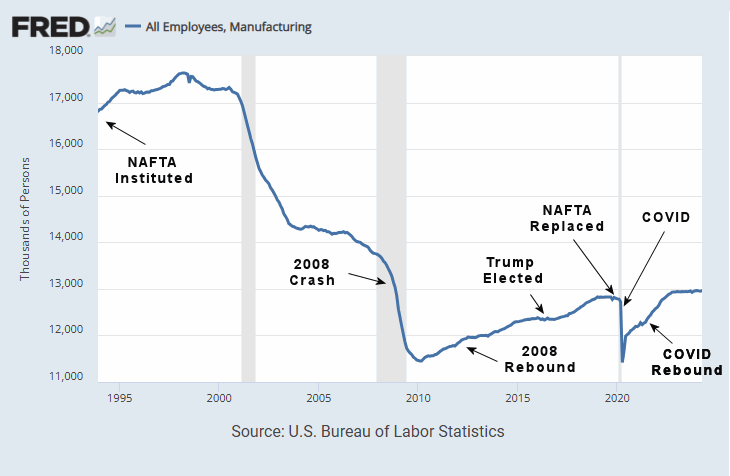
In the following chart we can see what happened to U.S. Manufacturing jobs since the implementation of the NAFTA free trade deal in 1994. According to Business Insider, apparently Ross Perot was correct that NAFTA would create a “Giant Sucking Sound” as manufacturing jobs left the U.S., despite all the pundits arguments to the contrary. And we can see that Trump’s policies did have some effect on manufacturing jobs despite Obama’s predictions. But we have a long way to go to return to 1990s manufacturing employment levels. These days the biggest employment sectors are primarily the service sectors of Education & Health, Leisure & Hospitality, Retail, and Professional & Business Services with Manufacturing a distant fifth. See October 2024 Employment Report.
According to a 2018 Forbes article, “China has been manipulating the global markets through their cheap currency policy for the better part of the past 25 years…” [now 30 years, editor] “…In pinning down their currency, they cornered the world’s export market. And in the process, they emerged as the second largest economy in the world.”
This massive influx of foreign currency allowed them to buy massive amounts of U.S. Treasuries which fueled cheap U.S. credit, so the U.S. Government played along. Despite losing jobs, the U.S. consumer was happy to play along to get cheap Chinese goods. But this primarily benefited China and the U.S. Government, American jobs went to China so the U.S. Economy suffered. But this suffering was masked by the way GDP is calculated.
The Dirty Little Secret of GDP
If we look at the definition of GDP anywhere online such as Investopedia the first thing we see for a definition is: “Gross domestic product (GDP) is the total monetary or market value of all the finished goods and services produced within a country’s borders in a specific time period.”
Just reading the definition you would think they add up the value of all the goods and services produced in the country and that is the GDP. But what most people don’t realize is that hidden inside the GDP calculation is a huge chunk of non-productive money. And that is Government spending.
How many goods and services does the Government produce? None! Their entire function is to take money from one place and spend it somewhere else. Ah, but what about all the weapons of war the government buys? Well, they were actually produced by private companies, you can’t count that again as government production. What the “government” portion of GDP is counting is simply bureaucracy pushing papers, creating legislation, enforcing legislation, etc. For fiscal year 2025, it is estimated that Government spending will be 46% of GDP.
So, almost half of everything produced in the U.S. doesn’t really exist. If Government spending was removed from GDP, GDP would be cut drastically.
Why This Matters
So, back to China. China rigs its currency, grows its economy and the U.S. Government plays along so it can spend without raising taxes. And every time this happened, U.S. manufacturing took a hit, and Government spending increased, so GDP didn’t decline. In other words, Government growth masked the decline in manufacturing. But what makes a country richer, more production, or more government? So, China produced more and got richer while the U.S. got poorer.
How Tariffs Can Help
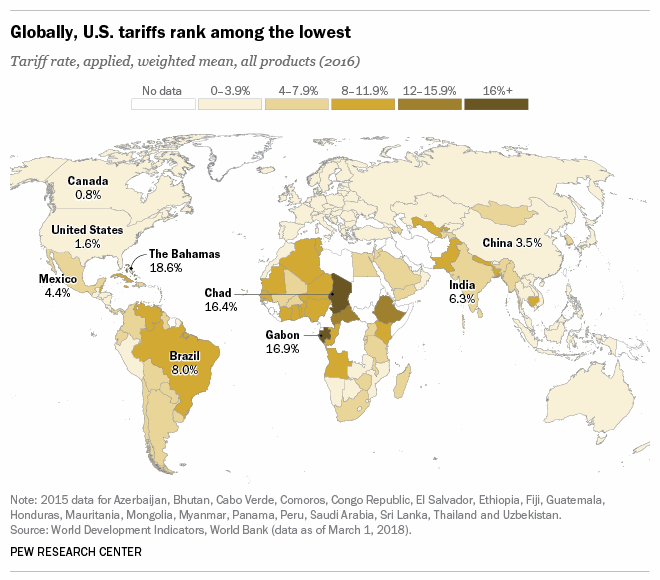
Tariffs can help level the playing field when currency exchange rates aren’t doing the job they should be. Interestingly, back in 2005, it was none other than Democrat Chuck Schumer who led the charge to impose a 35% tariff on China. This pressure eventually led to China somewhat revaluing its currency. According to a 2018 Pew Research article the U.S. was among the lowest tariffs in the world at 1.6%. China averaged 3.5%, Mexico averaged 4.4%, India averaged 6.3% and Brazil averaged 8.0%.
Since then some additional tariffs have been implemented on specific items. In 2018 President Trump announced a 25% tariff on steel and a 10% tariff on aluminum imports.
Biden has also resorted to tariffs in an effort to contain China’s aggressive trade practices. Of course, when Biden did it, the spin was… “President Biden Takes Action to Protect American Workers and Businesses from China’s Unfair Trade Practices”
Biden increased “tariffs across strategic sectors such as steel and aluminum [25%], semiconductors [50%], electric vehicles [100%], batteries [25%], critical minerals [25%], solar cells [50%], ship-to-shore cranes [25%], and medical products [50%].”
Note: Numbers in [ ] represent the new Biden Tariff.
According to a Fox News article: “When considering trade policy, it is important to recognize the difference between using tariffs to tilt the international playing field in favor of American businesses and using them as a negotiating tool… The U.S. objective in such negotiations would be to level a playing field tilted against American businesses, prevent a flood of foreign products designed to destroy American industrial sectors from pouring into our country, and protect our crown jewels of technology.”
Other countries use tariffs as well, Europe imposes a 10% tariff on U.S. car imports, China imposes a 25% tariff on U.S. Car imports and the U.S. charges 2.5% on foreign car imports. Is this fair?
Conclusion:
For years the U.S. has been subsidizing the rest of the world on an unfair playing field. Trump intends to use the threat of tariffs to help level that playing field and discourage U.S. manufacturers like John Deere from taking manufacturing jobs to Mexico.
Critics of the Trump plan look at the increased costs to consumers of imported goods as tariffs are enacted, but fail to see the increases in domestic production and jobs that these tariffs will produce. The other possibility is that just the threat of tariffs will cause a more level playing field and the U.S. will see additional benefits without any additional costs.
Read More:
- The Art of the Tariff Deal- Heritage Foundation
- Can Tariffs Really Replace the Income Tax?– Professor Peter St Onge
