
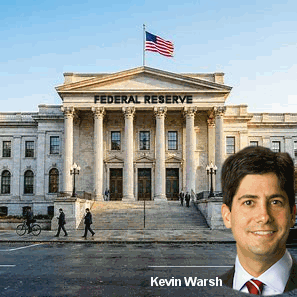
 The Federal Reserve is facing big changes, and this could be one of the biggest leadership shake-ups the central bank has seen in years.
Jerome Powell’s term as Federal Reserve Chair has come to an end. In a bit of an unusual twist, though, Powell isn’t walking out the door entirely. He’s staying on as a member of the Fed’s Board of Governors, since he’s still eligible to serve an additional two-year term. His voice will still be in the room, even if he’s no longer running the show.
Kevin Warsh Takes the Helm
Taking Powell’s place is Kevin Warsh, who cleared the Senate in what turned out to be the narrowest confirmation vote for a Fed Chair in modern history. It wasn’t a comfortable margin, but a win is a win, and Warsh is now positioned to put his stamp on the central bank.
Warsh has some unconventional views for a Fed Chair. He has previously called Bitcoin “the new gold” for the under-40 generation, a comment that raised more than a few eyebrows in traditional financial circles. Whether that perspective influences any Fed policy remains to be seen, but it signals a willingness to think outside the usual central banking playbook.
He’s also expected to shake things up internally, particularly around how the Fed communicates its decisions and manages its balance sheet. Those are two areas that have attracted significant criticism in recent years, so changes there could have real ripple effects across financial markets.
Stephen Miran Steps Down
Warsh won’t be inheriting the same board that existed under Powell. Federal Reserve Governor Stephen Miran has announced he will resign once Warsh is officially sworn in.
Miran joined the Fed board on September 16, 2025, filling an unexpired term set to run through January 31, 2026. Though his term expired on that date, Miran continued to serve in a “holdover capacity,” which is standard practice at the Fed, until his successor was sworn in. Warsh is the successor despite becoming Chairman.
Miran’s tenure was brief but notable. A self-described policy dove, Miran consistently voted in favor of cutting interest rates at every single policy meeting he attended. In some cases, he actually dissented because he wanted the Fed to cut rates by more than his fellow policymakers were willing to approve.
Before joining the Fed, Miran had a packed resume. He served as chairman of the Council of Economic Advisers under President Trump, worked as a senior strategist at Hudson Bay Capital Management, and held a fellowship at the Manhattan Institute for Policy Research. He also spent time as a senior adviser for economic policy at the U.S. Treasury Department from 2020 to 2021, following a decade in financial markets.
Miran’s Parting Positions
Miran made a few suggestions on his way out. He voiced strong support for eliminating “reputational risk” guidelines, which he argued allowed regulators to force their political views on issues like firearms and climate onto bank customers via banking regulations. He didn’t think that had any place in financial regulation. He also favored reducing “excess regulation.”
He also warned that the Fed could end up fighting “fake rather than real inflation” if it doesn’t fix the biases baked into its economic models. The “fake” inflation he was referring to was temporary Iran-related price increases rather than inflation created by monetary policy (i.e., money printing).
On a more positive note, Miran said he’s excited about the changes Warsh plans to bring, especially around how the Fed talks to the public and manages its balance sheet.
What to Watch
The Fed under Warsh could look and sound quite different from what markets have grown used to. Between the new communication approach, potential balance sheet changes, a reshaping of regulatory philosophy, and a board still taking form, there’s plenty to keep an eye on in the months ahead.
You might also like:
- How will FED Chairman Warsh affect Rates and Inflation?
- Is the Fed Heading Toward Checkmate?
- The Truth About Truflation vs. the BLS’s CPI
- Will the Collapse of OPEC Result in Lower Oil Prices?
- The California Energy Crisis
- Energy Is Non-Fungible: Costing the World Billions
- The Pipes of Global Finance Are Getting an Upgrade
- Why Greenland Matters: U.S. Strategy and Influence in the Arctic
Image Created by Bing AI w/ edits
