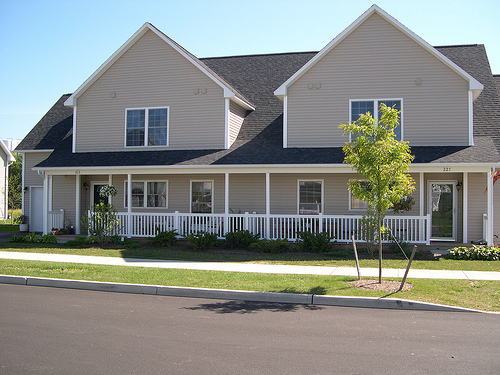
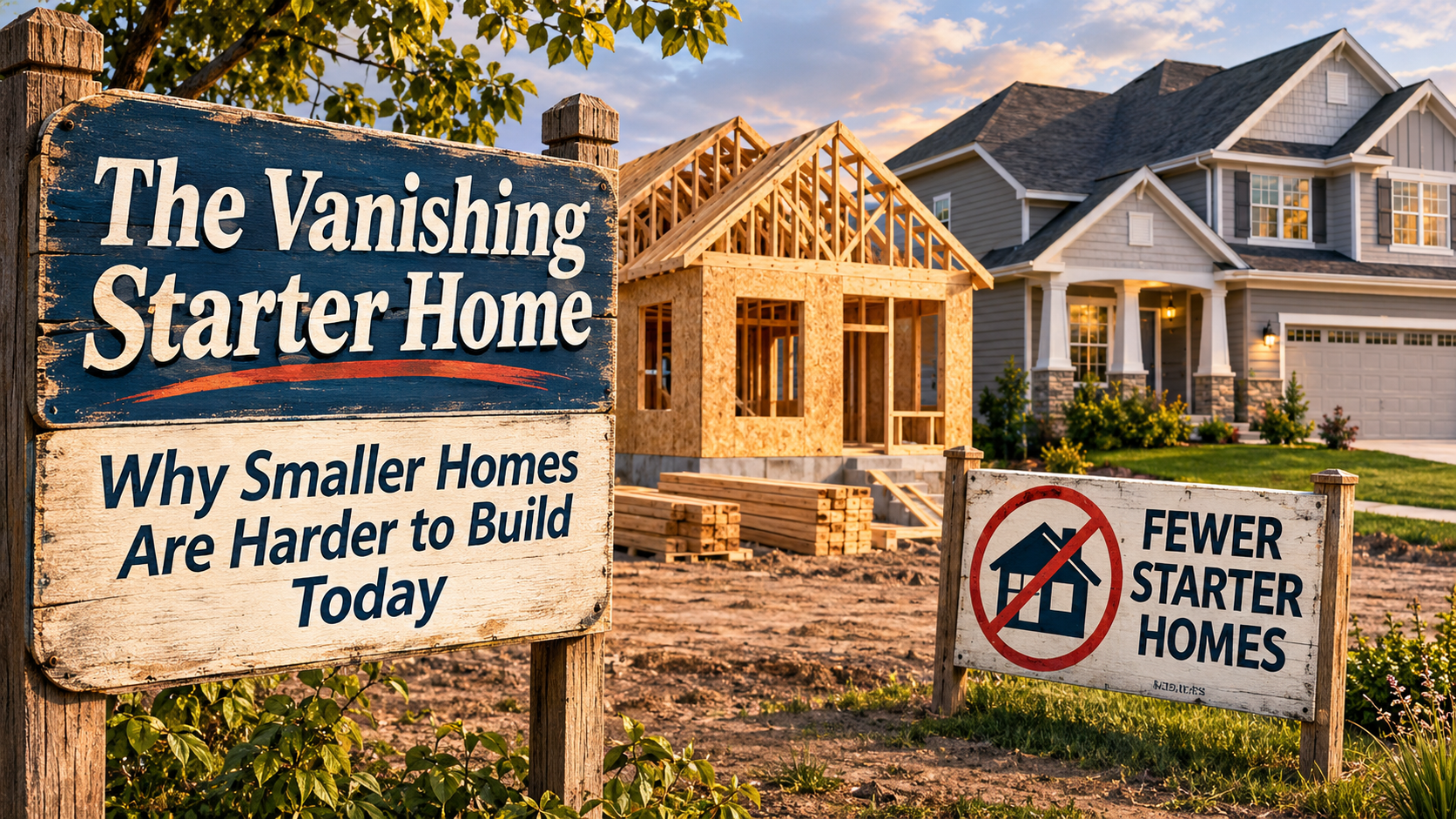
 Housing affordability is a hot topic these days, and for good reason… Very few starter homes are being built these days. In a competitive market, rising demand should encourage developers to build more of the homes and apartments that people want. Then, as supply increases, competition among sellers and landlords should help moderate prices.
America’s housing problem isn’t necessarily that there aren’t enough homes. It’s that it has become harder for builders to make money building smaller ones.
It may seem obvious that if Americans need less expensive houses, builders should simply build more starter homes. After all, you’d think, a 1,200-square-foot house should cost considerably less to build than a 2,400-square-foot house. But the economics of homebuilding aren’t quite that simple.
The Economics of Building Smaller Homes
Unfortunately, many building costs stay about the same whether the house is big or small. Consider two homes: one measuring 1,200 square feet and another measuring 2,400 square feet. The smaller home has half the living space, but it still needs a kitchen, at least one bathroom, electrical service, plumbing, heating and air conditioning, a roof, a foundation, utility connections, and permits.
Many of these expenses are relatively fixed, whether you build a large or small house.
The builder has to purchase the land, prepare the building site, connect utilities, pay applicable development fees, and cover financing and marketing costs. Those expenses can represent a substantial portion of the final selling price.
In other words, cutting a house’s size in half doesn’t cut the cost of building it in half.
Bigger homes give builders more room to cover their fixed costs, like land, well and septic, foundations, building permits, etc.
This isn’t really greed. It’s just how business works. Builders take on a big risk when they buy land, borrow money, get approvals, and build homes, so each project has to make enough money to cover expenses, profit, and risk.
The Federal Reserve Bank of Minneapolis examined this problem in its article, “The Vanishing Starter Home.” It described how rising costs of land, labor, and regulation pushed some builders out of the lower-priced market. One builder interviewed said that it was no longer practical to focus on the true first-time homebuyer market and was forced to shift toward more expensive homes.
Recent numbers back this up. Cotality found that only about 20% of new homes built in 2025 were under 1,500 square feet, down from about 32% in 2011. Even the smaller homes had a median price of around $340,000 as of April 2025.
So even when builders construct smaller houses, buyers aren’t necessarily getting the bargains they might expect. But the problem isn’t all on the builder.
Rising Buyer Expectations
Buyers’ expectations have also changed. A starter home in the 1950s might have had only two bedrooms, one bathroom, a small kitchen, and a carport. Today, many buyers expect an open floor plan, granite or quartz countertops, stainless steel appliances, walk-in closets, a primary suite with its own bathroom, and a two-car garage. Builders know that a bare-bones house can be harder to sell, especially when it sits next to a newer home packed with upgrades. So even when builders could build a simpler, cheaper house, they often add features modern buyers have come to expect, which pushes the price up again.
Government Regulations Make the Problem Worse
Construction economics are only part of the problem. Local zoning laws and building regulations can make affordable housing even more difficult to produce.
Many communities impose minimum lot sizes, minimum house dimensions, setback requirements, parking requirements, and other restrictions that limit what developers can build.
Imagine a developer who wants to develop ten acres of land. With fewer rules, he might choose to build a neighborhood of modest homes on small lots. But if local zoning laws require larger lots, limit how many homes can be built, or set minimum house sizes, the developer may be forced to build fewer homes that each cost more. The land still costs the same amount, but fewer homes are available to cover that expense.
Minimum lot sizes matter because they raise the land cost behind every home. A buyer might want to build a modest 1,000-square-foot house, but local rules may still force them to buy a big, expensive lot.
Permit delays, impact fees, infrastructure requirements, and other development costs also add up. Some fees are charged per home, no matter how big it is. So, a small house can end up with many of the same regulatory and development costs as a much larger one.
These rules can make it unprofitable to build the homes that lower- and middle-income buyers need most.
The Disappearance of the Starter Home
For much of the postwar period, American builders constructed relatively modest homes that allowed young families to enter the housing market. These houses weren’t necessarily luxurious, but they provided an affordable starting point.
Buyers could purchase a smaller home, build equity over time, and eventually move into something larger as their incomes increased.
That traditional path to homeownership has become increasingly difficult.
These factors have forced builders to focus on bigger homes with extra bedrooms, bathrooms, garages, and upgraded features. These homes appeal to higher-income buyers and give builders a better chance to make back their high land and construction costs.
The result is a housing market where first-time buyers often must compete for older homes because newly constructed alternatives are priced beyond their budgets.
That puts buyers in a pinch. People who want a modest house often can’t find one, and under today’s costs and rules, builders can’t afford to build it.
What Would Make Housing More Affordable?
The solution isn’t simply to tell builders to construct smaller houses. Policymakers need to make it economically feasible to do so.
That means reconsidering minimum lot sizes, allowing smaller homes and narrower lots, reducing unnecessary permitting delays, and making it easier to build duplexes, townhouses, and other forms of higher-density housing.
It also means examining development fees and regulations that impose disproportionately high costs on smaller projects.
Not every neighborhood needs to have big houses on big lots. Some families want a large home with a big yard. Others would happily take less space in exchange for a smaller mortgage payment.
A healthy housing market should offer both choices.
Ultimately, housing has become harder to afford for several reasons: too few homes, pricey land, rising building costs, and government rules that often limit what kinds of homes builders can put up.
When regulations make smaller homes unprofitable to construct, builders naturally gravitate toward more expensive properties.
The irony is that many Americans can’t afford the homes that are being built, and the homes they could afford are getting harder and harder to build profitably.
You might also like:
- Why Hasn’t the Free Market Made Life More Affordable for the Average American?
- Federal Student Loans Drive Up College Tuition Levels
- Will Loan Forgiveness Raise College Costs?
- How Affordable Was the 1950s American Dream?
- Income Inequality Misconceptions in the U.S.
- Cost of Living
- Is Gas Really More Expensive Than Ever?
- How To Recalculate Retirement for Today’s Economy
- The Hidden Cost of “Free” Healthcare and College in Scandinavia