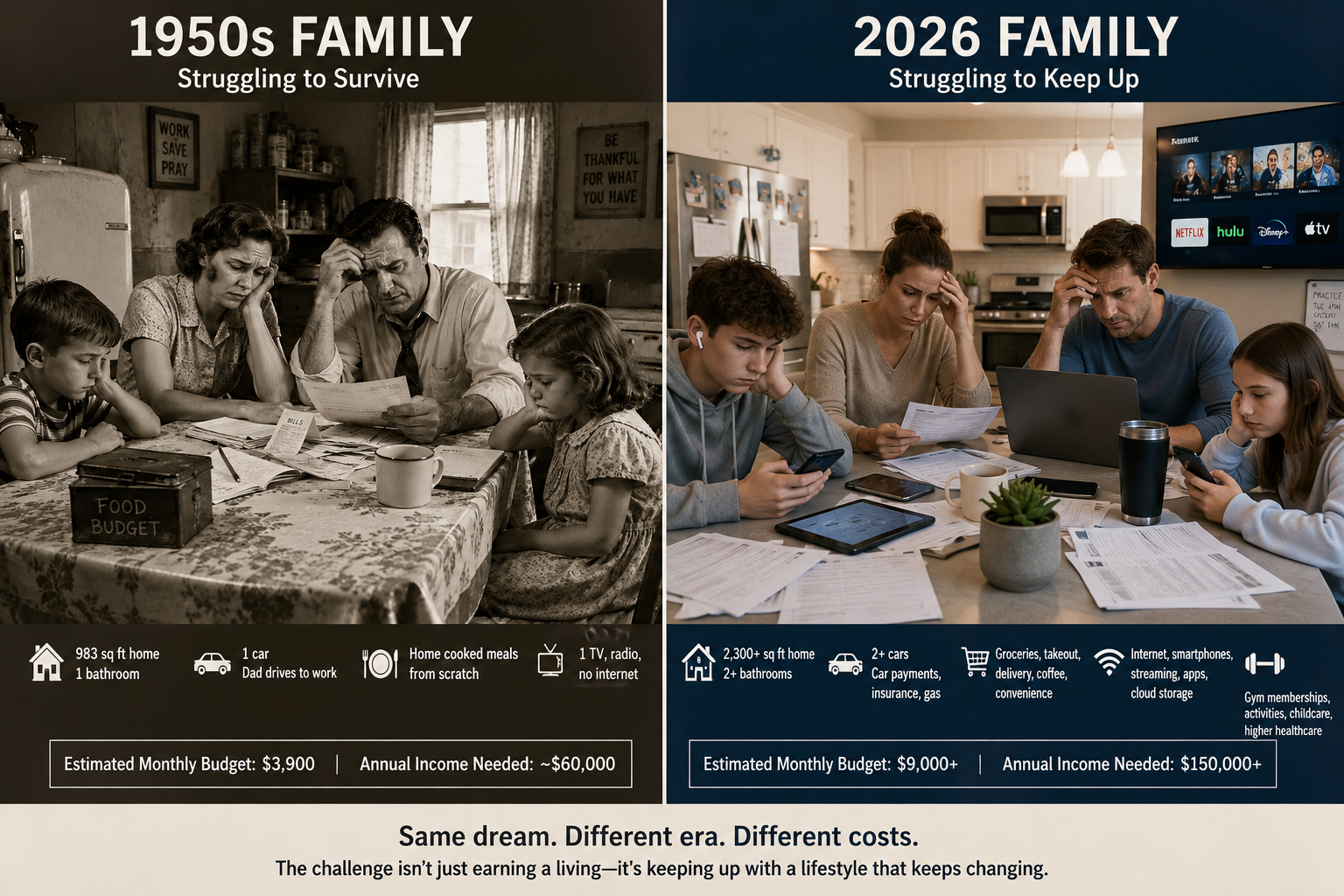
Note: the numbers in the above graphic are all in 2026 Dollars.
Based on unrealistic expectations fostered by TV shows like Happy Days and Leave it to Beaver, young people of today think we had it much better back in the 1950s and 60s. Homeownership is often portrayed as something 1950s families could afford but today’s families can no longer afford, but today over 65% of American families own their own home. While in 1950, only 55% of families could afford to buy a house. So, homeownership rates have actually increased since 1950.
Year
Homeowners
Renters
1950
55%
45%
2025
65.2%
34.8%
If you want a 1950s lifestyle today, it would only require about $60,000 a year in gross household income (in 2026 Dollars).
The important caveat is that you would also have to accept the lifestyle that came with it.
Homes built during the 1950s were dramatically smaller than today’s standards. The average newly constructed house in 1950 only measured only 983 square feet and had little to no insulation! In rural America, woodstoves were still common, and many homes still relied on them as the primary or supplemental heat source and many didn’t have indoor plumbing!
By 1950, most urban families had indoor bathrooms (with 1 toilet, 1 small sink, 1 Tub, no shower), but roughly one-third of American homes still lacked complete indoor plumbing. In many rural communities, using an outhouse remained part of daily life.
Year
Homes Without Indoor Plumbing
1940
About 45%
1950
About 35%
1960
About 14%
1970
About 5%
Most newer suburban houses had just two or three small bedrooms, and a single bathroom shared by everyone in the family. Although window air conditioners existed, they were far from universal. Most American homes in 1950 had no air conditioning at all, relying instead on open windows, fans, shade trees, awnings, and sleeping porches. During hot nights you didn’t get much sleep. Even by the 1960s, the majority of homes still did not have air conditioning. Countertop microwave ovens for consumers did not appear until the late 1960s, and even then they were big, heavy, and expensive. Microwaves didn’t become truly mainstream until the 1970s as prices dropped and reliability improved.
The classic 1950’s American Dream consisted of a modest home, a family car, and 2.5 children.
What many people consider necessities today were not part of everyday life or didn’t even exist.
What the 1950s Lacked:
No microwave oven
No dishwasher
Often no Washing Machine (used a laundromat)
No clothes dryer
No second toilet.
No master bathroom.
No garbage disposal.
No cable television
No personal computers
No internet
No smartphones
No streaming subscriptions
No meal delivery services
2020s vs. 1950s Expenses:
A home comparable to a 1950s home today might be an older 1,000-square-foot house or condominium in a reasonably priced housing market. At approximately $200,000, a buyer making a 20% down payment would typically spend about $1,500 per month on the mortgage, property taxes, and homeowners insurance.
Transportation was equally modest. Most households owned only one vehicle (which lacked seatbelts, A/C, power windows, power steering, and power brakes). The family’s wage earner (almost universally the Father) generally drove it, while the stay-at-home Mom relied on walking, nearby neighborhood services, or evening shopping for the weekly groceries. Laundry was done at a Laundromat and took a couple of hours a week.
Re-creating that arrangement today means maintaining one dependable used vehicle, carrying a single insurance policy, and paying for less fuel overall. That comes to roughly $600 per month.
Eating habits have changed just as much. Restaurant meals were reserved for special occasions in the 1950s, and takeout was not a regular part of family life, even McDonald’s was a rare event. Nearly every meal was prepared at home using inexpensive ingredients such as potatoes, ground beef, pasta, canned vegetables, and other pantry staples. Following a similar approach today allows a family of four to keep grocery costs in the neighborhood of $900 to $1,000 per month, consistent with the USDA’s low-cost food plan.
Many expenses that strain modern budgets simply did not exist decades ago. Families did not pay for daycare because one parent typically stayed home. There were no internet bills, smartphone plans, streaming subscriptions, cloud storage fees, or monthly app memberships. There was a single telephone attached to the wall with no way to contact the working spouse in case of an emergency. Phone plans charged extra for “Long-Distance” calls, which often meant anyone outside your immediate neighborhood (so long-distance calls were reserved for special occasions and only made at “off-peak” rates), and you only had the choice of one carrier. Entertainment centered on a television (which only had 3 local stations), a radio (3 more local stations), books, board games, and outdoor activities. Clothing purchases were infrequent, and garments were often repaired instead of replaced.
Putting the numbers together paints an interesting picture. At today’s prices, this lifestyle would cost:
Housing: $1,500 per month
Transportation: $600 per month
Groceries: $1,000 per month
Utilities, healthcare, and miscellaneous: $800 per month
Total: $3,900 per month or approximately $47,000 in annual after-tax spending, which translates to a gross household income of roughly $60,000.
Year
Median Family Income
1950
About $3,300
1955
About $4,400
1960
About $5,600
The real difference is not simply that the American Dream has become unattainable. Today’s definition of a basic lifestyle includes many conveniences and services that did not exist in the 1950s. Living like a typical family from that era is still financially possible for many households. It simply means accepting one bathroom, one car, home-cooked meals, and life without many of the technologies that have become part of everyday living.
Year
Estimated Poverty Rate
1950
About 22%
1959 (first official estimate)
22.4%
2024 (latest official)
10.6%
The social safety net in the United States is much larger and more comprehensive today than it was in 1950. Many of the programs people now rely on either did not exist or were far more limited.
Here’s a comparison:
1950
Today
Limited welfare assistance
Multiple federal and state assistance programs
No Medicare
Medicare for seniors and certain disabled individuals
Limited Medicaid (did not exist)
Medicaid for low-income individuals and families
Smaller Social Security benefits
Larger Social Security program with COLAs
No Supplemental Nutrition Assistance Program (food stamps began in the 1960s)
SNAP provides food assistance to millions
No Earned Income Tax Credit
EITC supplements earnings for working families
No Children’s Health Insurance Program
CHIP covers millions of children
Limited unemployment benefits
Broader unemployment insurance system
No housing vouchers
Federal rental assistance and housing vouchers
While many people argue that life was easier in the 1950s, families also had far less government support when financial hardship struck. If you lost your job or faced a medical emergency, there were almost no public assistance programs to fall back on.
Work by editor and author, Tim McMahon, has been featured in Bloomberg, CBS News, Wall Street Journal, Christian Science Monitor, Forbes, Washington Post, Drudge Report, The Atlantic, Business Insider, American Thinker, Lew Rockwell, Huffington Post, Rolling Stone, Oakland Press, Free Republic, Education World, Realty Trac, Reason, Coin News, and Council for Economic Education.
Used only with old Urchin versions of Google Analytics and not with GA.js. Was used to distinguish between new sessions and visits at the end of a session.
End of session (browser)
__utmz
Contains information about the traffic source or campaign that directed user to the website. The cookie is set when the GA.js javascript is loaded and updated when data is sent to the Google Anaytics server
6 months after last activity
__utmv
Contains custom information set by the web developer via the _setCustomVar method in Google Analytics. This cookie is updated every time new data is sent to the Google Analytics server.
2 years after last activity
__utmx
Used to determine whether a user is included in an A / B or Multivariate test.
18 months
_ga
ID used to identify users
2 years
_gali
Used by Google Analytics to determine which links on a page are being clicked
30 seconds
_ga_
ID used to identify users
2 years
_gid
ID used to identify users for 24 hours after last activity
24 hours
_gat
Used to monitor number of Google Analytics server requests when using Google Tag Manager
1 minute
_gac_
Contains information related to marketing campaigns of the user. These are shared with Google AdWords / Google Ads when the Google Ads and Google Analytics accounts are linked together.
90 days
__utma
ID used to identify users and sessions
2 years after last activity
__utmt
Used to monitor number of Google Analytics server requests
10 minutes
__utmb
Used to distinguish new sessions and visits. This cookie is set when the GA.js javascript library is loaded and there is no existing __utmb cookie. The cookie is updated every time data is sent to the Google Analytics server.