
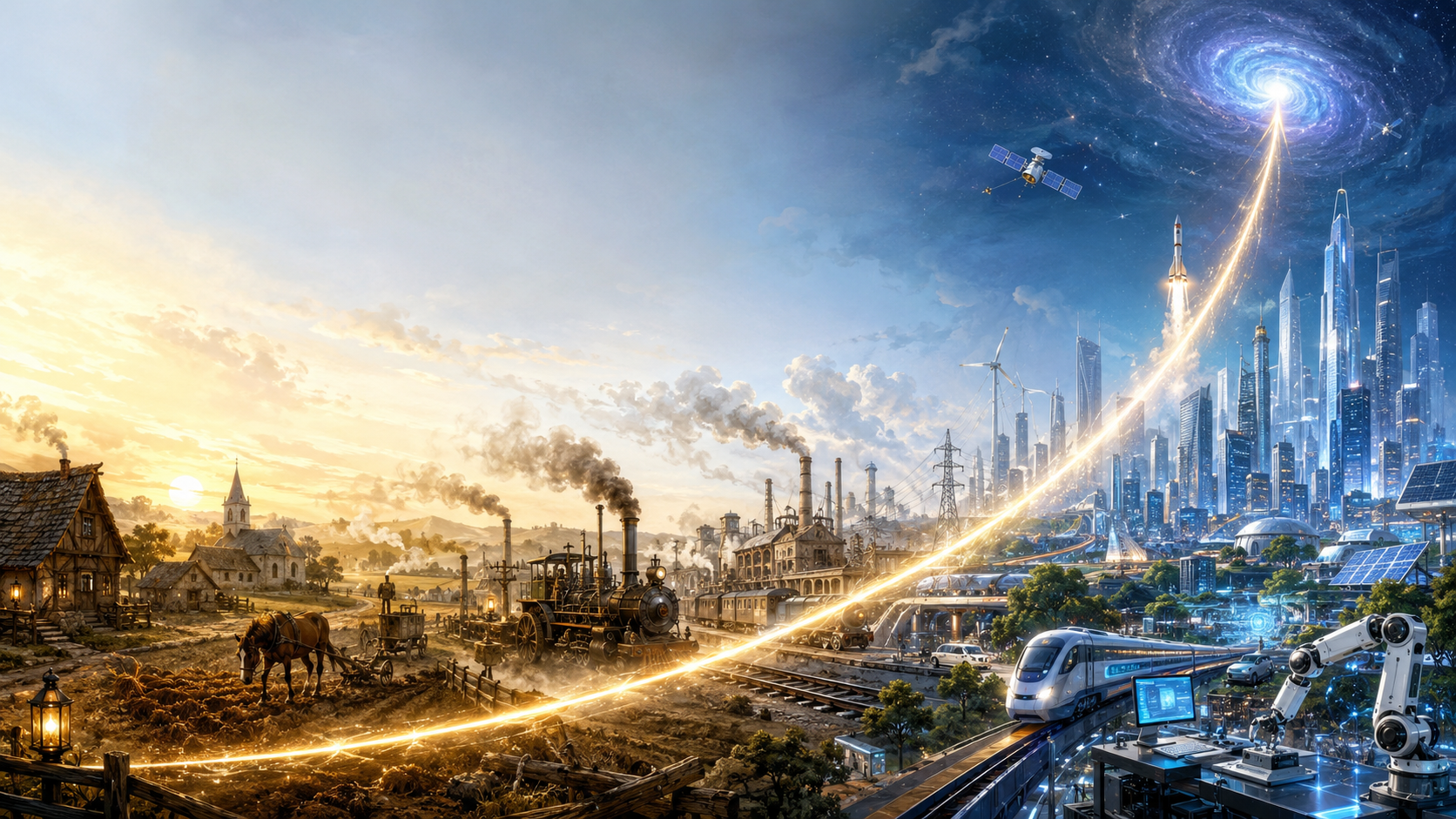
 I recently read an interesting essay about The Singularity. The term originally came from physics, describing the center of a black hole where matter becomes so compressed that the normal laws of space and time cease to have meaning.
Over time, futurists borrowed the word to describe the point when artificial intelligence surpasses human intelligence and technological change becomes impossible to predict.
But the article offered a different perspective. Rather than arguing that the Singularity is a future event waiting for superhuman AI, it argues that humanity entered the Singularity more than 200 years ago with the Industrial Revolution. AI isn’t the beginning of the Singularity. It’s simply the latest stage of a transformation that has already been reshaping civilization for centuries.
Whether or not you agree with that conclusion, the evidence becomes difficult to ignore when you step back and look at the long arc of human history.
Five charts tell an extraordinary story.
For Thousands of Years…Almost Nothing Changed
For almost all of history, life was remarkably consistent and depressing. Half of all children died before adulthood. Energy came almost entirely from wood, animals, and human labor. Most people lived in abject poverty. Literacy was rare. Economic growth was so slow that one generation lived almost exactly like the one before it.
Then, beginning around 1800, nearly every long-term trend in human history suddenly changed. Not gradually. But exponentially.
Chart 1: Child Mortality Collapsed
For most of recorded history, nearly half of all children died before reaching adulthood. That statistic barely changed for thousands of years. Then advances in sanitation, nutrition, medicine, vaccines, and public health caused child mortality to collapse. Today the global average is only a fraction of what it was just seventy-five years ago.
This may be the greatest improvement in human welfare ever achieved.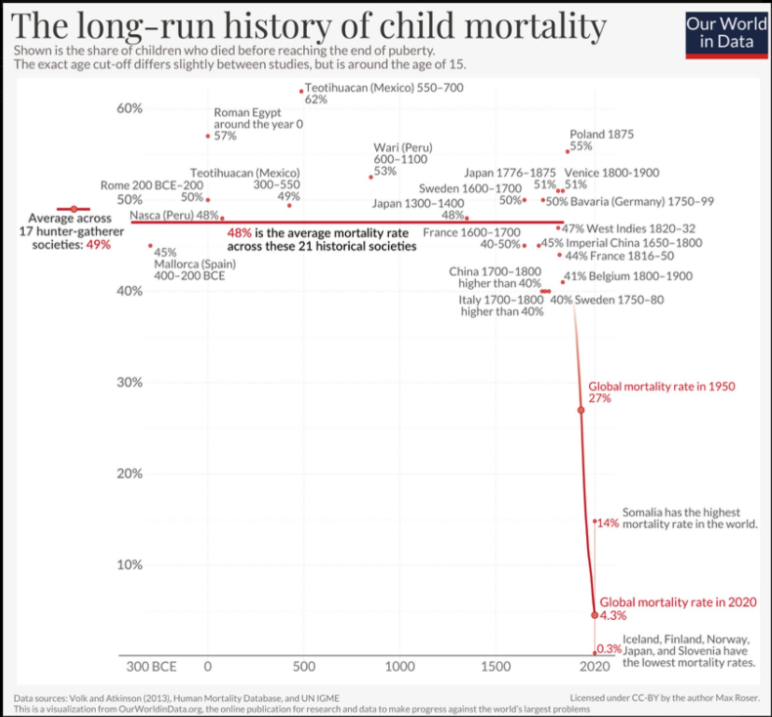
Chart 2: Energy Changed Everything
For thousands of years, humanity used roughly the same amount of energy per person. Then came coal. Then oil. Then natural gas. Then electricity.
Modern civilization is essentially the story of humans learning to harness vastly more energy. Every factory, computer, hospital, transportation network, and AI data center ultimately depends on abundant energy. Without the explosion in available energy, almost every other chart in this article would remain flat.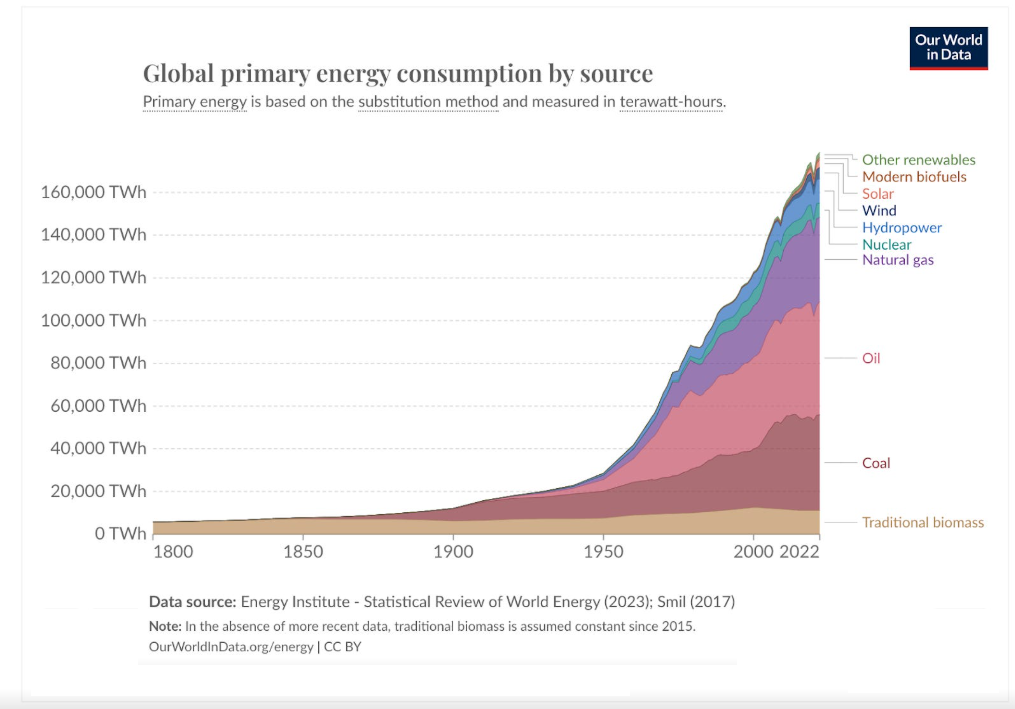
Chart 3: Economic Output Went Vertical
England’s GDP remained relatively stagnant for centuries. Then the steam engine sparked the Industrial Revolution and mechanization, factories, railroads, electrification, and eventually computers transformed productivity. Economic growth that once took centuries began to happen within decades.
Today, economies generate wealth on a scale unimaginable to previous generations.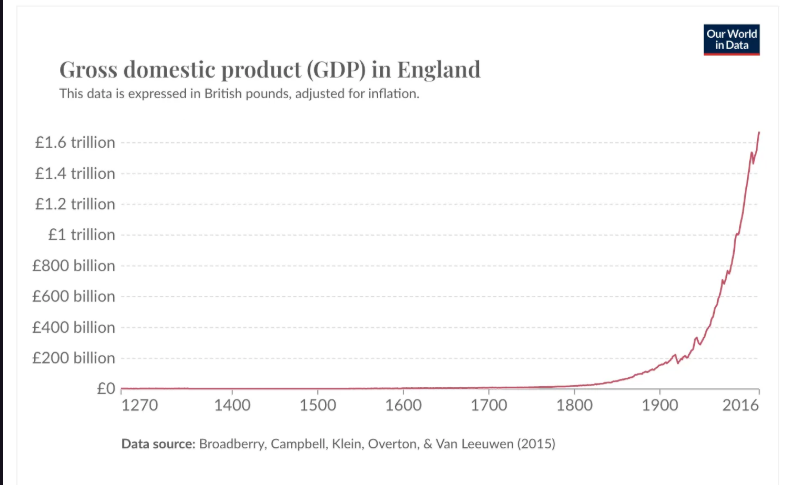
Chart 4: Literacy Became the Norm
For most of history, reading and writing were skills reserved for a small elite. Books were scarce. Education was limited. Information moved slowly. Over the past two centuries, universal education spread across much of the world, and literacy became the expectation rather than the exception.
That single change unlocked science, innovation, entrepreneurship, and democratic participation on a massive scale.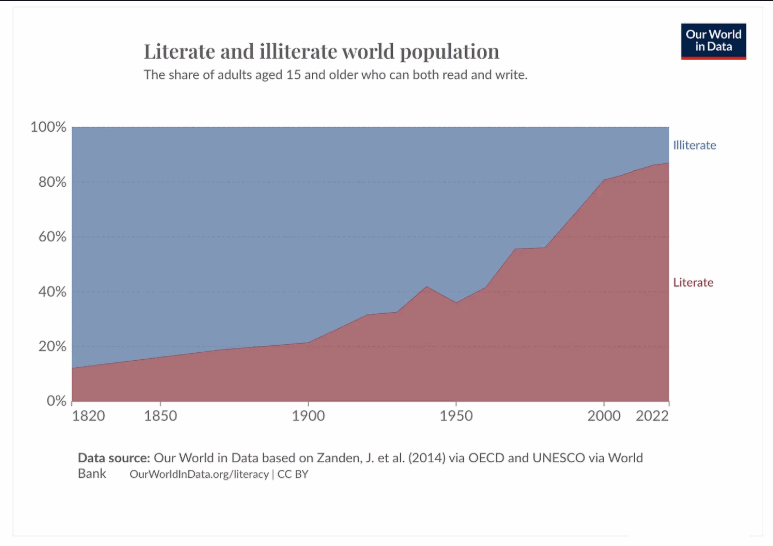
Chart 5: Extreme Poverty Collapsed
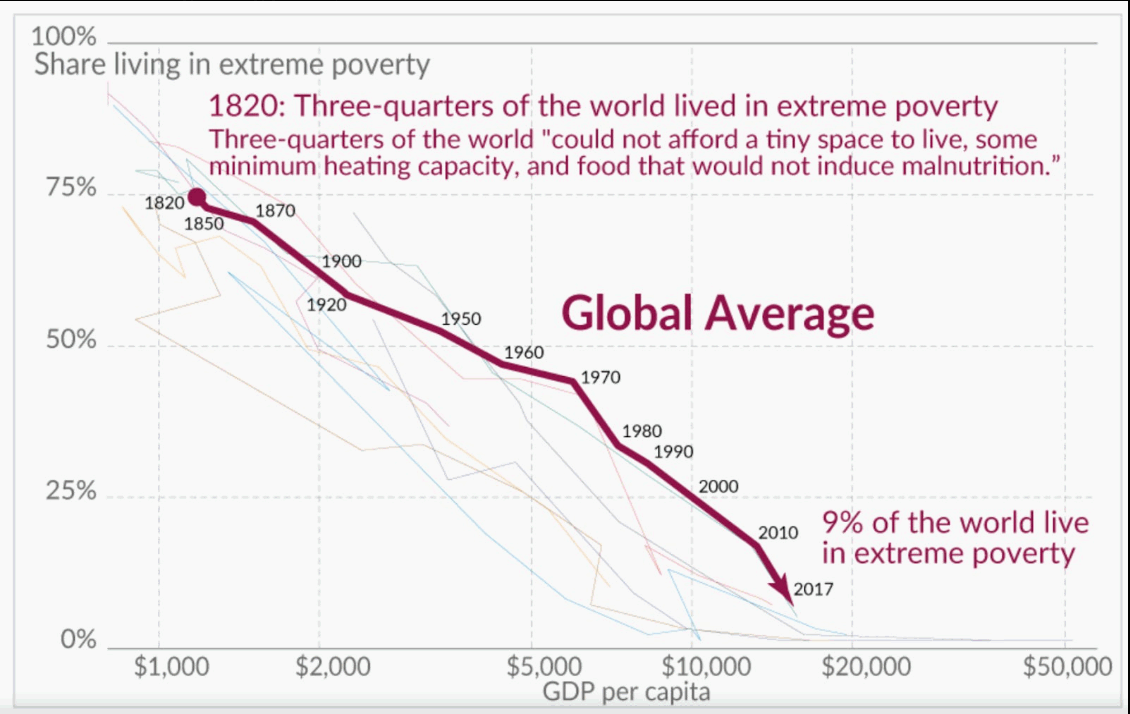
Perhaps the most remarkable chart of all. Around 1820, roughly three out of every four people on Earth lived in extreme poverty. Today, despite enormous regional differences, that figure has fallen dramatically. Billions of people now enjoy standards of living that kings could scarcely imagine two centuries ago.
Movies have given us an idealized picture of what ancient life was like by focusing only on the wealthy. But for thousands of years, extreme poverty was simply the human condition. Whether you lived in ancient Egypt, medieval Europe, imperial China, or the Americas, the overwhelming majority of people struggled every day to secure enough food, clothing, shelter, and fuel to survive. We may picture ancient Rome as endless toga parties, but in reality, 20 – 30% of the population were slaves and 90 – 95% of the population lived at or just above subsistence levels. And one out of every two Mayflower passengers died during their first winter in America.
Throughout history, famines were common, life expectancy was short, and even “small” setbacks like a failed harvest or an illness could be catastrophic. There were a few wealthy kings and nobles, but they represented a tiny fraction of humanity. For everyone else, poverty wasn’t an economic cycle; it was a permanent state of existence.
Most wealth consisted of productive assets: fertile farmland, livestock, workshops, ships, mines, and the limited infrastructure built by human hands. Since technology advanced slowly, these assets produced only slightly more from one generation to the next. If someone became dramatically richer, it was often because they acquired someone else’s productive assets through conquest, inheritance, political power, or trade, rather than by creating entirely new wealth. Thus the idea became ingrained in the human psyche that acquiring wealth quickly was evil (or at least questionable).
Then something remarkable happened. Beginning in the early 1800s, the line on the chart begins to bend downward for the first time in history. Wealth was no longer a zero-sum game. The Industrial Revolution overturned that reality. Steam engines, electricity, factories, modern medicine, computers, and the internet didn’t simply redistribute existing wealth; they created entirely new wealth. A farmer with a tractor could produce many times more food than one with a horse. A factory worker operating machinery could manufacture products that had once required hundreds of craftsmen. Software developers can now create products used by billions of people with almost no additional cost to reproduce them. Productivity exploded, and with it came higher incomes, longer lives, better housing, safer food, and access to goods and services that previous generations could scarcely imagine.
This is one reason modern capitalism is so often misunderstood. When entrepreneurs build products that millions voluntarily buy because they improve their lives, they aren’t merely taking a larger slice of a fixed pie. In many cases, they’re baking an entirely bigger pie. The fortunes created by people like Henry Ford, Bill Gates, Steve Jobs, Jeff Bezos, Elon Musk, and Jensen Huang largely arose because they developed products and technologies that dramatically increased productivity or created value for hundreds of millions of people. Their companies became enormously valuable because they helped make society wealthier, not simply because they transferred wealth from others to themselves.
The Common Thread
Each chart tells a different story. Together they tell the same story. For nearly all of human history, civilization changed very slowly.
Then around the beginning of the Industrial Revolution, nearly every measure of human progress accelerated at roughly the same time:
- Child mortality fell.
- Energy production exploded.
- Economic output accelerated.
- Literacy spread.
- Extreme poverty declined.
These aren’t isolated trends.
They’re different expressions of the same underlying force: accelerating technological progress.
And Now Comes AI
If Raoul Pal and David Mattin are correct, artificial intelligence isn’t the beginning of the Singularity. It’s another acceleration within a process that has already been underway for more than two centuries. Every previous wave of technology expanded humanity’s productive capacity by allowing us to do more physical work with fewer people.
AI appears poised to do something similar for cognitive work. That doesn’t mean the future will be smooth. Every major technological revolution has disrupted industries, eliminated jobs, created entirely new ones, and forced societies to adapt. But history suggests that betting against human innovation has rarely been a winning strategy.
The five charts above remind us of something easy to forget amid today’s headlines: We are living through one of the most extraordinary periods in the entire history of our species. And if AI delivers even a fraction of what its advocates expect, these charts may look almost flat compared with the ones our grandchildren will be studying.
Read the original article here.
You might also like:
- How Affordable Was the 1950s American Dream?
- What Is the K-Shaped Economy? Everything You Need to Know
- The Hidden Cost of “Free” Healthcare and College in Scandinavia
- The California Energy Crisis
- Energy Is Non-Fungible: Costing the World Billions
- The Pipes of Global Finance Are Getting an Upgrade
- Overcoming Power Grid Demand Problems- Then and Now
- Breaking Free from China’s Rare Earth Monopoly
- CBDCs vs. Stablecoins: One Protects Your Wealth, One Threatens It
