
 There’s an ongoing debate that surfaces every election cycle in America, and it usually goes something like this: one side points to Scandinavia as proof that socialism works, the other dismisses it as unaffordable fantasy. Both sides are working with an incomplete picture. The truth is more nuanced.
The “Tax the Rich” Myth
The most common assumption about how Nordic countries fund free healthcare and tuition-free universities is that they soak the wealthy. It’s a politically satisfying story. It’s also mostly wrong.
Scandinavian governments generate the revenue for their massive welfare states by heavily taxing the middle class… consistently, and on nearly everything they buy. That’s not a critique. It’s just the mechanism, and understanding it changes the entire debate.
Three Pillars of the Nordic Revenue Machine
The Nordic model rests on three structural pillars, and none of them are “eat the rich.”
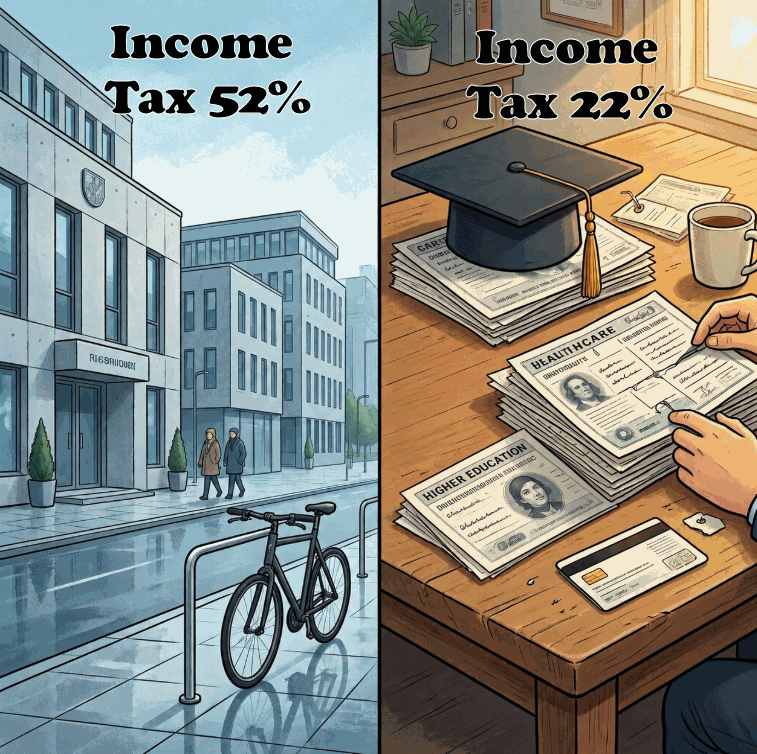
Income taxes with a short ladder. In Sweden and Denmark, the top marginal tax rate kicks in at just 1.2 to 1.5 times the average national income. So, nurses, teachers, and mid-level engineers are all in the highest bracket. A U.S. nurse at $70K pays a 22% federal marginal rate. A Danish nurse at an equivalent income hits a marginal rate of around 56% (Denmark’s top rate) or Sweden’s ~52%.
A 25% sales tax on almost everything. Nordic countries levy a Value-Added Tax of 25% on nearly all goods and services. Every grocery run, every appliance, every meal out. Economists correctly note that VAT is regressive — lower-income households spend a higher share of their earnings on consumption than wealthy ones do. But that’s also what makes it such a stable revenue engine. It collects from everyone, all the time, regardless of what markets are doing. The U.S., by contrast, has no federal sales tax. State and local rates average around 7% to 8%, with carve-outs for groceries and medicine that further reduce the take.
Surprisingly low corporate taxes. Here’s the part that tends to surprise people on both sides of the debate. Nordic corporate tax rates average around 21% to 22%… almost identical to the current U.S. federal corporate rate of 21%. Scandinavia is not punishing businesses. The model is explicitly designed to keep companies competitive globally, because thriving businesses employ people, and employed people pay income taxes and VAT. The welfare state runs on payroll taxes, not on corporate penalties.
What the U.S. Model Actually Looks Like
The American tax structure isn’t a less generous version of the Nordic model. It’s a different philosophy entirely.
Total U.S. tax revenue runs around 27% to 28% of GDP. Scandinavian countries collect between 42% and 46%. That 15 to 18 percentage point gap doesn’t vanish — it reappears in hospital bills, student loan balances, private retirement accounts, and childcare costs that American households absorb individually.
The U.S. system bets that you are better at allocating your own money than the government is. The Nordic system bets the opposite. Both bets have consequences. That second bet looks shakier every time a state audit uncovers nine-figure Medicaid fraud, phantom employees on public payrolls, or COVID relief funds that somehow ended up financing luxury real estate.
So Is Scandinavia Capitalist or Socialist?
This is where the framing of the debate breaks down entirely.
Scandinavia is not socialist in any meaningful economic sense. These are capitalist economies with robust private sectors, stock markets, property rights, and globally competitive corporations. The former Danish Prime Minister said it directly during a U.S. visit: “Denmark is far from a socialist planned economy. Denmark is a market economy.”
Beginning in the 1800s, Nordic countries spent roughly a century building prosperity based on free markets with a small public sector before the welfare state arrived. Then around 1970, they shifted to higher taxes and Socialized benefits. But in just 15 years, the economy had stalled, and a crisis followed. The following course correction is the part that rarely makes it into the American political debate. In light of the burgeoning financial crisis, Sweden cut marginal tax rates, abolished the wealth and inheritance taxes. They also privatized Government businesses, reformed the pension system, and deregulated financial markets, telecoms, and transportation. Today, roughly 20% of all welfare services are delivered by the private sector.
What they’ve built is a high-tax welfare state layered on top of capitalism. Capitalism came first, socialist overreach broke it, and market reforms fixed it. However, for decades, by spending less than 2% of their GDP on defense, most Nordic countries effectively outsourced their security expenses to the U.S. military. The welfare state is more affordable when someone else is covering the defense tab.
The U.S., meanwhile, is not a pure free-market system either. Medicare, Medicaid, ObamaCare, Social Security, SSDI, SSI, SNAP, WIC, National School Lunch Program, Section 8 housing vouchers, Low Income Housing Tax Credit, Pell Grants, Federal student loans, Title I school funding, and home energy assistance all represent a significant collective financing of major life expenses. The U.S. just does it at the point of use, and increasingly on borrowed money, rather than current tax revenue.
The real difference isn’t capitalism versus socialism. It’s a question of when and how you pay.
The Prepayment Model vs. the Pay-As-You-Go Model
Think of it this way. The average Scandinavian household surrenders roughly half its income to various taxes and then pays high VAT on everything they buy with the half they have left. In exchange, they get to feel good about never receiving a hospital bill, paying for university tuition, or paying for childcare. The major expenses of modern life have been prepaid collectively. They’ve been baked into the tax rate and are invisible by design.
But “free” and “available” aren’t the same thing. Waiting lists are a built-in feature of the Nordic model. They act as a natural rationing mechanism in systems where cost control takes priority over rapid access. When a Scandinavian needs “elective” surgery, the bill may be zero, but the wait can be substantial. Even within the system, higher-income patients tend to wait less than lower-income ones, so there may be universal coverage, but not perfectly equal in practice; a system that would seem entirely unfair to equality-minded Americans.
Rationing goes beyond wait times. The Nordic model makes eligibility decisions at the policy level that determine who qualifies for certain procedures in the first place. Denmark’s experience with bariatric surgery is a stark example. In 2011, the government tightened eligibility criteria, raising the BMI threshold from 40 to 50 for patients without serious comorbidities and raising the minimum age from 18 to 25. The effect was immediate: annual procedures collapsed from 0.9 per 1,000 inhabitants to just 0.2. Norway formalized this gatekeeping in 2013 with a national system for managed introduction of new health technologies… so basically, a bureaucratic body decides which treatments will get reimbursed at all. Expensive cutting-edge treatments and cancer drugs have been denied coverage through this process. And when the rationing problem gets bad enough, the fix turns out to be injecting market competition by allowing private for-profit providers to compete for publicly funded patients to pressure public hospitals into becoming more efficient. Capitalism, quietly called in to rescue the socialist model.
University tells a similar story. “Tuition-free” doesn’t mean “open-door”. There is no guarantee of admission. Norwegian universities require a minimum grade equivalent to a U.S. “B” average just for the privilege of competing for a place, and KTH (Sweden’s largest technical university) only accepts about 30% of applicants to their Master’s program. The financial barrier is gone. The academic one remains.
On the other hand, the average American household keeps significantly more of its gross income, pays lower sales tax, and then spends some of the savings on healthcare, education, and retirement, although all three do have some government safety nets. On the plus side, there are colleges available for everyone, you can get elective surgery without waiting years, and you choose what healthcare you want. In addition, the most cutting-edge treatments are available if you can afford them.
Neither system is free. One front-loads the cost. The other back-loads it.
