Aluminum-ion technology promises 50,000 charge cycles, 3,000-mile EV range, and zero fire risk — at 20% less cost. Is this the energy storage breakthrough that rewrites the rules?
Aluminum-Ion Batteries: A Potential Breakthrough in Energy Storage
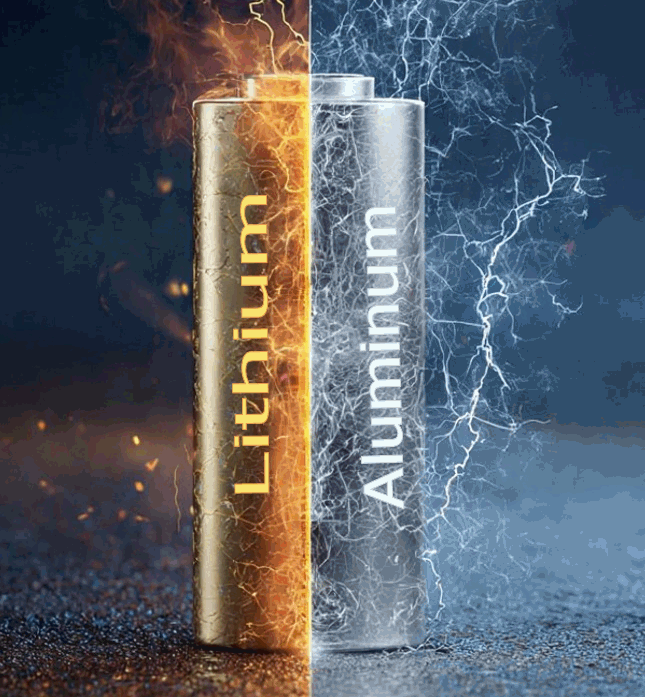
As global demand for energy storage accelerates—driven by electric vehicles, renewable integration, and grid resilience—the limitations of lithium-ion batteries are becoming increasingly clear. While lithium-ion technology has dominated for decades, a new contender is emerging with the potential to redefine the landscape: aluminum-ion batteries.
At first glance, aluminum may seem like an unlikely challenger. However, a closer look reveals a compelling set of advantages that could make aluminum-ion chemistry a disruptive force in both transportation and stationary storage markets.
An aluminum-ion cell can theoretically deliver around 50,000 full charge-discharge cycles over its lifetime, compared to roughly 2,000 for today’s best lithium-ion chemistries. That’s not an incremental improvement — it’s a paradigm shift. At that cycle count, a battery installed in a car today might still be performing at spec in 2095.
The Abundance Advantage
The core advantage starts with raw materials. Unlike lithium, which faces geopolitical supply risks and environmentally destructive mining, aluminum is one of the most abundant metals on Earth. It is not scarce, not concentrated in a handful of politically sensitive countries, and not subject to the kind of supply shocks that have rattled the EV supply chain repeatedly since 2020. This abundance directly translates to economics.
The Cost Advantage
Aluminum-ion batteries are projected to be roughly 20% cheaper to manufacture at scale than comparable lithium packs. Lower input costs mean cheaper EVs, more affordable grid-scale storage, and fatter margins for manufacturers who pivot early.
For grid-scale storage — where cost per kilowatt-hour is essentially the only metric that matters — that gap is decisive. For consumer EVs, it translates to either a lower sticker price or a much larger pack for the same price.
“Aluminum carries three times the charge per ion that lithium does. That’s the physics working in your favor from the first principles up.”
But cost is only the beginning. The real story is longevity and durability. Where today’s lithium-ion EV batteries typically deliver around 2,000 full charge cycles before significant degradation, aluminum-ion designs are demonstrating 50,000 cycles or more. That’s the difference between a battery that lasts 5–8 years in daily use versus one engineered to endure 70 years. Imagine an EV power pack that outlives the vehicle itself—no more expensive replacements every decade, dramatically lowering total cost of ownership for fleets, consumers, and utilities alike.
The Safety Advantage
Safety is the clincher for insurers, regulators, and consumers. Lithium-ion packs carry an inherent fire risk from thermal runaway. They also have a tendency to form “dendrites”. Think of it like tiny metallic whiskers that slowly grow inside the battery during repeated charging cycles — microscopic tendrils of lithium metal that creep through the electrolyte. Over time, or during an aggressive fast charge, these whiskers can grow long enough to bridge the gap between the battery’s two electrodes and cause an internal short circuit, resulting in a dead cell (if you are lucky) or a fire (if you aren’t). To prevent this, lithium batteries require elaborate management systems to operate safely.
Aluminum-ion batteries don’t have this issue. The way aluminum deposits during charging doesn’t produce dendrites, and the ionic liquid electrolyte used in most aluminum-ion designs is non-flammable to begin with. The result is a battery that can take a fast charge, absorb physical abuse, and still carry no meaningful fire risk. They’re inherently stable, making them ideal for everything from passenger cars to data centers and residential solar storage.
Emerging designs are even incorporating self-healing mechanisms that automatically repair micro-damage at the electrode level, further extending cycle life and maintaining peak efficiency over decades. This self-healing property, combined with the ultra-high cycle count, positions AIBs as the ultimate “set it and forget it” storage solution.
The Charging Advantage
Charging time remains a critical barrier to widespread electric vehicle adoption. Aluminum-ion batteries offer a major leap forward in this area, with the ability to recharge significantly faster than lithium-ion systems. In some experimental setups, full charging can occur in minutes rather than hours.
This capability could eliminate “range anxiety” not just by extending range, but by making refueling as quick and convenient as filling a gas tank.
The Electrochemistry: Why Aluminum Works
Lithium carries a single positive charge per ion (Li?). Aluminum carries three (Al³?). In battery terms, this means each aluminum ion shuttling between electrodes during a charge or discharge cycle moves three times the electrical charge that a lithium ion does. That trivalent nature is the fundamental physical reason aluminum-ion cells can pack significantly more energy into the same space — or the same energy into a much smaller and lighter package.
The implications for EV range are staggering. Extrapolating from the energy density potential, aluminum-ion packs could theoretically support driving ranges of up to 3,000 miles on a single charge — roughly nine times what a well-equipped lithium EV currently delivers. Even discounting aggressively for engineering realities, a commercially viable aluminum-ion EV pack delivering even a third of that would still be a revolutionary product.
|
Why This Matters for Grid Storage The combination of low cost, ultra-long cycle life, and no thermal risk makes aluminum-ion an exceptionally compelling candidate for utility-scale grid storage — the sector where lithium’s limitations are most acute and where the world needs capacity most urgently over the next decade. |
The 70-Year Battery
Combine the 50,000-cycle figure with fast recharge capability and the self-healing electrode behavior, and you arrive at a projected service life measured not in years but in decades. Independent engineering analyses have suggested that an aluminum-ion battery deployed in the right application could remain functional and within specification for approximately 70 years. That is not a battery — it is infrastructure. For grid operators, utilities, and municipalities considering large-scale energy storage investments, a 70-year asset life transforms the entire capital allocation calculus.
The Catch: Where Things Stand Today
If aluminum-ion batteries are so compelling, why isn’t every EV manufacturer already switching? The honest answer is that the technology is not yet commercially mature. Prototype cells have demonstrated impressive performance in laboratory settings, but scaling up electrochemical processes while maintaining performance and cost targets is notoriously difficult. Achieving a consistent ionic liquid electrolyte supply at manufacturing scale remains a challenge. And the incumbent lithium-ion supply chain is enormous, entrenched, and represents trillions of dollars in sunk infrastructure investment. The vanadium flow battery is an instructive cautionary tale here. A decade ago, vanadium was generating similar excitement — superior cycle life, no fire risk, long-duration storage potential. Then lithium-ion prices dropped 90% through the 2010s, faster than almost anyone predicted, and vanadium got squeezed into a narrow grid-storage niche it’s never escaped. Aluminum-ion could face a version of the same story if solid-state lithium chemistry — currently attracting billions in R&D investment from Toyota, Samsung, and others — matures faster than anticipated and closes the performance gap before aluminum reaches commercial scale.
The Investment Signal
For investors and trend-watchers, aluminum-ion sits in a familiar but high-stakes position: a technology with genuinely superior fundamentals that is still navigating the gap between laboratory validation and commercial deployment. The companies that solve the manufacturing challenge — consistent electrolyte production, electrode stability at scale, cost-competitive cell assembly — stand to capture an enormous market. The global battery market is projected to exceed $500 billion annually by 2035, and grid storage alone represents a multi-trillion-dollar buildout requirement over the next 30 years.
Aluminum is not the only lithium alternative being pursued. Sodium-ion, solid-state, iron-air, and flow battery chemistries are all attracting serious capital. But aluminum’s combination of raw material advantages, safety profile, energy density potential, and cycle life durability gives it a credible claim to being the most comprehensive improvement on lithium-ion currently in development. That doesn’t mean it wins. Battery technology history is littered with promising chemistries that stalled at scale. But it does mean that anyone tracking the energy storage transition needs aluminum-ion on their radar — and sooner rather than later.
Tesla’s Current Stance
Despite widespread online speculation, YouTube hype, and rumor-filled articles linking Tesla to aluminum-ion (or “super aluminium-ion”) Tesla has made no official announcements, demonstrations, or confirmations regarding any aluminum-ion battery development or deployment.
Elon Musk and Tesla have remained silent on the topic, with no mentions in earnings calls, Battery Day updates, or recent product roadmaps. Independent analyses and fact-checks consistently classify these stories as unverified speculation or outright fiction. Tesla’s current strategy instead emphasizes incremental lithium optimizations and structural battery packs that already deliver class-leading range, safety, and cost reductions without the need for a full chemistry overhaul.
For investors and enthusiasts watching the aluminum-ion narrative unfold in the broader market, Tesla’s silence serves as a reminder that real breakthroughs must clear rigorous internal validation and gigafactory-scale production hurdles before they reach customers.
The Bottom Line
Aluminum-ion batteries represent a compelling vision of the future: cheaper, safer, longer-lasting, and dramatically more powerful than today’s lithium-ion standard. If even a portion of their theoretical advantages can be realized at scale, the implications for electric vehicles, renewable energy, and global energy infrastructure would be profound.
| Stat | Aluminum-Ion | Lithium-Ion |
|---|---|---|
| Charge cycles | ~50,000 | ~2,000 |
| EV range (projected) | Up to 3,000 mi | ~330 mi |
| Energy per ion | 3× more (Al³?) | Baseline (Li?) |
| Service life | ~70 years | 8–15 years |
| Relative cost | ~20% cheaper | Baseline |
| Fire / thermal risk | None | Significant |
| Material scarcity | Abundant globally | Moderate to high |
| Heat during fast charge | Minimal | Significant |
Competing Battery Technologies:
- Batteries: New Sea-Water-Based Battery to Replace Lithium
- New Solid-State Battery Design
- Turning Nuclear Waste into “Perpetual” Batteries
Read More:
- Overcoming Power Grid Demand Problems- Then and Now
- The Truth About AI and Electricity Capacity
- Will AI And Bitcoin Mining Balance Or Destroy the Grid?
- Breaking Free from China’s Rare Earth Monopoly
- Why Graphene Hasn’t Taken Over the World- Yet
Tags: Batteries | Energy Storage | Electric Vehicles | Clean Energy | Emerging Technology | Commodities