
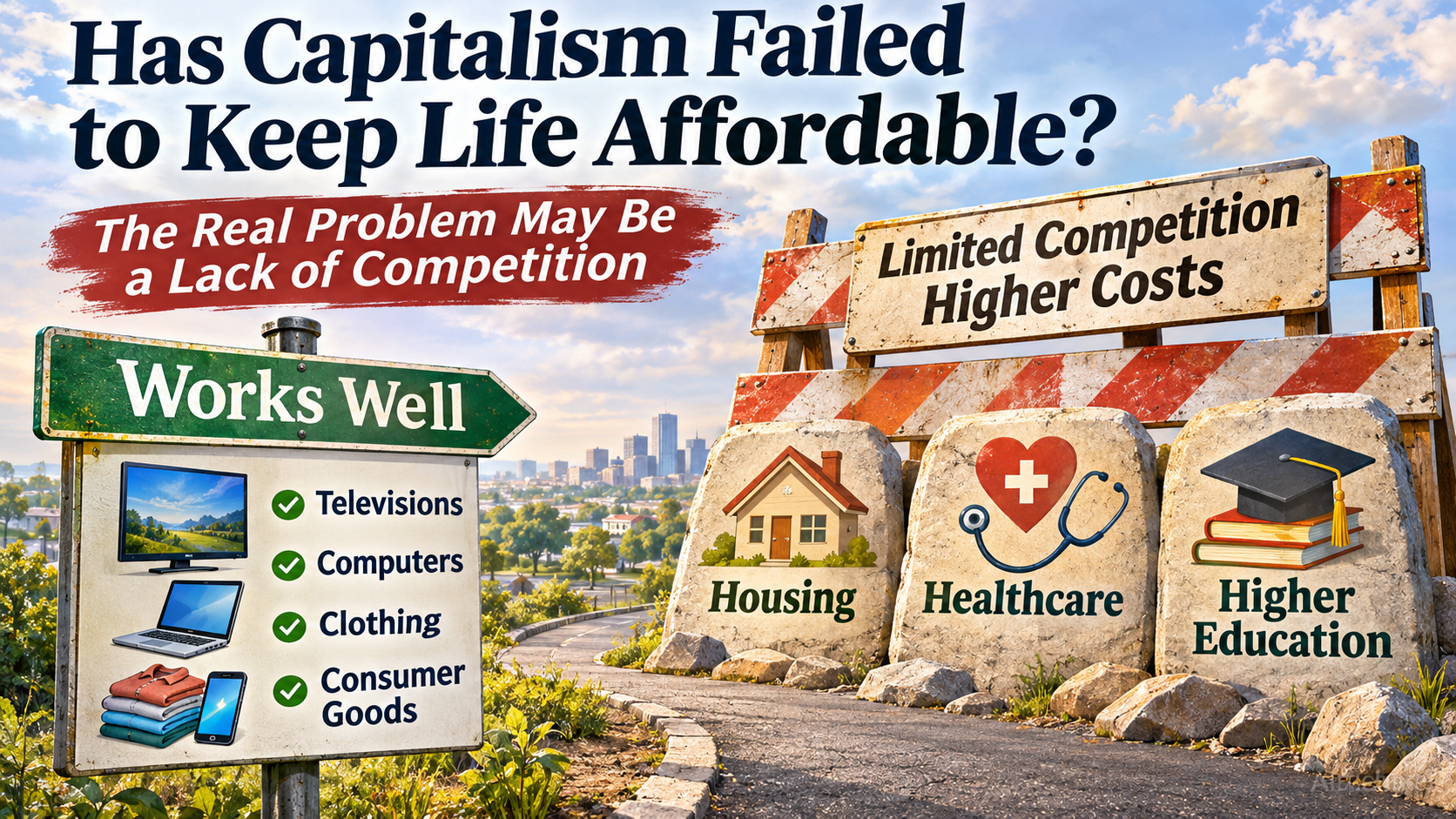
 Lately, capitalism has gotten the blame for rising prices, but is that really the problem? Perhaps a little surprisingly, the free market has actually made many everyday products more affordable. Televisions, computers, clothing, and many consumer goods cost less today, in inflation-adjusted terms, than they did a generation ago. Competition, technological advances, automation, and global trade have helped drive down many prices, and in many cases… while improving quality.
So why does life seem less affordable for the average American?
The answer isn’t the failure of capitalism, but rather the lack of a free market in certain sectors. The three biggest expenses weighing on household budgets are housing, healthcare, and higher education. Unfortunately, these sectors often lack the competitive pressures that have made other goods and services more affordable.
Housing: When Government Restricts Supply
Housing is typically the largest expense in an American household budget. In a free market, rising demand should encourage developers to build more affordable homes and apartments. Then, as supply increases, competition among sellers and landlords should help moderate prices.
But housing markets often don’t work that way.
State regulations, zoning laws, building restrictions, lengthy approval processes, and opposition from local residents often make it difficult to build new housing, particularly in desirable cities. Restrictions on apartment buildings and higher-density development can artificially restrict the number of available homes.
The result is a classic supply-and-demand problem. When demand increases, but supply is restricted, prices rise.
Factors include land costs, construction expenses, interest rates, and labor shortages. Nevertheless, restrictive zoning and permitting policies can make an already difficult affordability problem considerably worse.
In many communities, the problem isn’t that developers are unwilling to build more housing. Local rules discourage building affordable, smaller starter homes and instead encourage larger, more expensive homes.
Healthcare: A Market Where Consumers Rarely See the Price
Healthcare presents an entirely different challenge. In competitive markets, consumers can compare prices before buying. If one business charges too much, customers can go elsewhere.
Healthcare rarely works that way.
Most Americans receive healthcare through employer-sponsored insurance, government programs, or other third-party payment arrangements. As a result, patients often have little idea what a procedure, test, or treatment will cost until after they receive it.
When someone else is paying the bill, traditional price competition becomes unimportant. Providers may have less incentive to compete aggressively on price, while patients have limited ability or incentive to shop around.
Insurance networks, hospital mergers, drug patents, and red tape all limit competition, which makes the problem even worse.
This doesn’t mean regulation is unnecessary. Healthcare involves patient safety, complex medical decisions, and circumstances where ordinary consumer choice is limited. But regulations that protect established providers or discourage new competitors can drive up costs.
The result is a healthcare system where prices are often difficult to understand, competition is limited, and consumers have relatively little control over what they pay and even less incentive to try to reduce costs.
Higher Education: Easy Credit and Rising Tuition
College costs have soared for decades, leaving many students with debt that follows them for years after graduation.
Rather than helping, student loans contribute to the problem. Yes, they’ve helped more people go to college, but they’ve also changed how colleges behave.
When students can borrow large sums to pay tuition without understanding the consequences, schools have little incentive to keep prices down. Rather than competing on affordability and quality of education, schools have begun to compete based on things like lazy rivers, climbing walls, massage studios, and golf simulators.
Universities can increase tuition while students finance the difference with borrowed money. The immediate cost is less visible, but the debt eventually comes due.
When the government pumps money into demand but does nothing to rein in what colleges spend, prices just keep going up.
The Bigger Picture: Competition Matters
Free markets work very differently from markets where regulation, government policy, or structure keeps competition in check.
Consider consumer electronics. Companies that fail to offer better products at competitive prices risk losing customers to competitors. That constant pressure encourages innovation, efficiency, and lower costs.
But when housing supply is restricted, healthcare prices are obscured, or educational institutions have access to a steady supply of subsidized credit, incentives change.
Has the Free Market Failed to Lower the Cost of Living?
Rather than asking whether the free market has failed, perhaps the better question is whether it has been allowed to work effectively in the areas that matter most to consumers.
Markets work best when new businesses aren’t faced with a mountain of red tape, high startup costs, and other barriers to entry. Prices should be out in the open; companies should have to compete for every customer. Government regulations shouldn’t favor either buyers or sellers.
The cost-of-living crisis isn’t simply a story of inflation or stagnant wages. It’s also a story about supply constraints, distorted incentives, restricted competition, and policies that produce unintended consequences.
If lawmakers really want to make life more affordable for everyday Americans, they need to look past draconian fixes and encourage building smaller affordable housing, opening up healthcare to real competition, making prices transparent, and reforming college incentives.
Ultimately, a competitive marketplace is one of the most effective tools for keeping prices in check. The question is whether we’re doing enough to let competition work where Americans need it most.
You might also like:
- The Hidden Cost of “Free” Healthcare and College in Scandinavia
- Federal Student Loans Drive Up College Tuition Levels
- Will Loan Forgiveness Raise College Costs?
- How Affordable Was the 1950s American Dream?
- Income Inequality Misconceptions in the U.S.
- Cost of Living
- Is Gas Really More Expensive Than Ever?
- How To Recalculate Retirement for Today’s Economy