
2026 Update:
What happened to the Nuclear waste perpetual batteries?
Betavoltaic batteries — sometimes called nuclear diamond batteries or atomic batteries. Here’s the story:
The concept… they work by capturing electrons released from radioactive decay and converting them into electricity. No chemical reaction, no charging needed — just continuous low-level power output for as long as the isotope keeps decaying, which in some cases is thousands of years.
The diamond battery buzz (2016–2020). The big wave of excitement came from the University of Bristol, which announced they could embed radioactive carbon-14 — extracted from decommissioned nuclear graphite reactor waste — inside a lab-grown diamond. The diamond acts as both a radiation shield and a semiconductor. The pitch was elegant: take nuclear waste that costs billions to store safely, and turn it into batteries that last thousands of years.
Why it went quiet? The power output is extraordinarily low — we’re talking microwatts, not the watts or kilowatts you need for anything practical. They’re not going to power your phone or your car. Ever. The physics simply don’t allow it at a useful scale.
Where they actually work
- Pacemakers (they were used in early cardiac pacemakers in the 1970s)
- Deep space probes where solar power is impractical
- Remote sensors in locations where battery replacement is impossible
- Military applications
Current status: A startup called Nano Diamond Battery was still raising money as recently as 2023 on the consumer battery angle, which drew considerable skepticism from physicists. The more credible commercial path is ultra-low-power IoT sensors and medical implants — not consumer electronics.
 Previous Article:
As the old saying goes, “when the world gives you lemons make lemonade”. And that is exactly what some scientists at the University of Bristol are trying to do.
Since the beginning of Nuclear power, the problem has been how to dispose of the radioactive waste. The major problem is the longevity of the stuff. If it takes 5000+ years to reduce by half (half-life) it certainly needs a durable container to keep it safe.
Over the years, disposal methods have included burying it in abandoned mines and various methods of encapsulating it such as inside glass. It has even been suggested that we ship it to the sun in rocketships since the sun is primarily a giant nuclear reactor anyway. But there are currently millions of tons of the stuff around the world so building enough rockets would be prohibitively expensive.
Nuclear reactors produce two types of waste, the first is the spent fuel rods and the second is the graphite which is used to absorb the radiation and act like a “brake” to shut down or slow the nuclear reaction. Spent fuel rods can also be reprocessed to recover some of the radioactive components but there is fear that it can also lead to Nuclear weapons proliferation… it is being done in Russia, Europe, and Japan.
As far as the graphite is concerned, once the graphite absorbs the radiation it becomes radioactive itself and so something must be done with it in order to make it safe. And that is where this new discovery comes in.
We think of diamonds as these rare, valuable, romantic items but much of that is simply marketing hype. In actuality, diamonds are not as uncommon as the Debeers cartel would have you believe. And now they can be manmade by simply placing a hunk of carbon under extreme pressure.
And graphite is carbon so…
By refining this radioactive graphite and then compressing it into a diamond and then surrounding it with a non-radioactive diamond this becomes an economical way to dispose of the waste graphite. But the interesting thing about it is that the researchers found that in the process these radioactive diamonds become miniature batteries. The typical AA battery weighs 23 grams and stores about 13,000 Joules of energy which can be depleted in roughly 1 day on continuous usage. One diamond with 1 gram of radioactive carbon-14 would only produce about 15 Joules per day so 23 grams of radioactive diamonds would produce about 345 Joules, still significantly less than an AA battery. But… it would still be producing half that much energy 5,730 years later!

The super long life expectancy makes these batteries perfect for applications where it would be difficult to replace the battery such as satellites or space stations. Another amazing application for non-radioactive graphite is in the creation of graphene. Read more about graphene.
You might also like:
- Why Graphene Hasn’t Taken Over the World- Yet
- Technological Solution to 100 Year Old Oil Problem
- New Battery UnVeiled
- Big Oil Betting On Electric Vehicles?
- Futuristic Advances to Ancient Materials
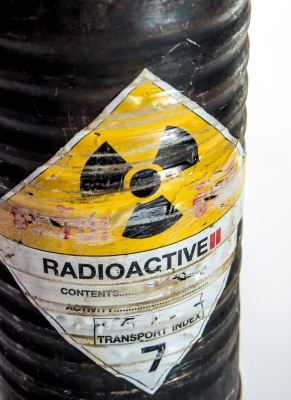
“Radioactive” image courtesy of SatakornS. at FreeDigitalPhotos.net
