
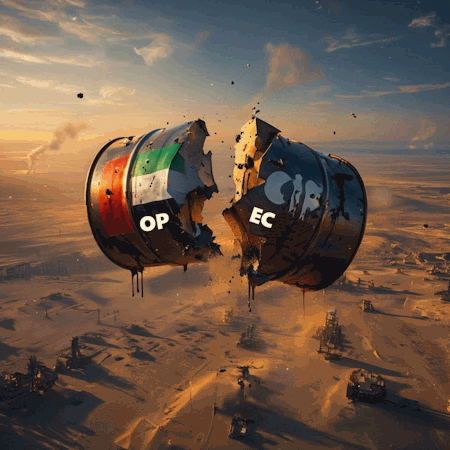
The UAE Just Walked Out on OPEC
OPEC — the Organization of Petroleum Exporting Countries — was founded back in 1960. For over 50 years, it has had a remarkably tight grip on global oil prices. The way it works is pretty straightforward: member countries agree to production quotas (caps on how much oil each country can pump), and by collectively controlling supply, they can push prices up or down. Here’s the thing that trips a lot of people up: even though the U.S. is “energy independent” in terms of domestic production, we’re still very much at the mercy of OPEC’s decisions. Why? Because oil is a global commodity traded on speculative futures markets. When OPEC sneezes, the oil market catches a cold — and we feel it every time we fill up the tank.
As the U.S. Energy Information Administration (EIA) explains, crude oil is bought and sold by speculators who don’t produce or consume a single barrel. They’re betting on future price changes — and OPEC’s announcements are one of the biggest factors that move those bets. A single statement from Riyadh can send oil prices climbing or crashing within hours, regardless of what’s actually being pumped out of the ground.
The UAE has been chafing under OPEC’s production limits for years. Before the current conflict in the region, the UAE had expanded its production capacity to 4.8 million barrels per day — but under its OPEC agreement, it was only allowed to pump 3.2 million barrels per day. That’s leaving enormous potential revenue sitting in the ground while countries like Russia and Iraq routinely cheat on their own quotas anyway.
There’s also a longer-term strategic play at work. Energy analysts point out that the UAE is essentially betting that we’ve hit “peak oil demand” — meaning global appetite for oil will gradually decline as the world transitions to cleaner energy. Their strategy is straightforward: pump as much as possible now, before oil becomes less valuable. That’s the exact opposite of Saudi Arabia’s approach, which is to keep production capped and prices high for as long as possible.
One of the most intriguing “what-ifs” in this whole situation is whether the UAE could eventually step in to fill the void left by Iran’s oil production. Before the current conflict, Iran was producing roughly 3.2 million barrels per day — but that output has been cratering under the U.S. naval blockade, with Goldman Sachs estimating Iran had already curtailed as much as 2.5 million barrels per day of crude output by late April. That’s an enormous hole in global supply. Here’s the thing: the UAE has invested billions of dollars in expanding its production capacity to 5 million barrels per day by 2027, but under its old OPEC agreement, it was capped at just 3.2 million bpd. Now that it’s walked away from those quota constraints, the UAE has roughly 1.6 million barrels per day of extra production capacity sitting in reserve — capacity it was previously forbidden from using. If the Strait of Hormuz reopens and peace returns to the region, the UAE could essentially flip a switch and unleash that spare output onto global markets, potentially offsetting much of the Iranian supply that has gone offline. It won’t happen overnight, and the geopolitics are messy — but the numbers line up in a surprisingly tidy way. The country that Iran was bombing just weeks ago may end up being the one that stabilizes global oil supply once the dust settles.
Here’s where it gets interesting — and where we have to be honest about the uncertainty involved.
The long-term case for lower prices: With the UAE free from OPEC quotas, it can produce and export as much oil as it wants. More supply in the global market generally means lower prices. Economists at Capital Economics note that “a more fractious and weaker OPEC could constrain the group’s influence on oil prices,” which would tend to push prices down over time.
The short-term reality check: Don’t hold your breath at the pump just yet. Right now, the Strait of Hormuz is effectively closed due to the ongoing Iran conflict. That’s already sent oil prices sharply higher, with Brent crude hovering around $117 a barrel and U.S. average gas prices sitting at a four-year high near $4.23 a gallon. The UAE’s exit from OPEC doesn’t instantly fix that bottleneck.
The volatility wildcard: Some analysts worry that a weaker, more fractured OPEC could actually mean more volatile prices rather than simply lower ones. When traders believe geopolitical risks are rising, they bid up oil futures, even without a real supply shock. And a destabilized OPEC removes one of the few mechanisms that historically helped put a floor (and a ceiling) under prices during crises.
The UAE’s exit is a major symbolic blow. OPEC now has just 11 members, and its ability to manage the market has been structurally weakened. Back in its heyday, OPEC controlled roughly half of global oil production. Today, thanks to booming output from the U.S., Norway, and others, that share has fallen to around 33 percent.
That said, OPEC isn’t going away tomorrow. Saudi Arabia still holds enormous sway, and the broader OPEC+ coalition (which includes Russia and other non-OPEC producers) still accounts for nearly 42% of global crude production. The club has survived internal squabbles before, including a near-complete collapse in 1985-86 that sent prices cratering for years.
In fact, that 1985-86 episode is worth remembering. When OPEC’s discipline broke down back then, the result was a six-year slide in oil prices, which was great for consumers but devastating for oil-producing economies.
The UAE leaving OPEC is genuinely significant. It weakens the cartel’s ability to artificially prop up oil prices, and over the medium-to-long term, that’s probably good news for gas prices in the U.S.
However, in the short term, the Strait of Hormuz situation, ongoing geopolitical uncertainty, and volatile oil futures markets mean prices could go in almost any direction. The oil market has always been as much about psychology and speculation as it is about actual supply and demand, and right now, there’s plenty of reason for nervous traders to keep prices elevated.
Related Reading:
Sources: Gen. Michael Flynn’s Substack | U.S. Energy Information Administration
Image: Bing A.I.
A Little OPEC Background
Why is the UAE Leaving OPEC?
What Does This Mean for Oil Prices?
The Bigger Picture: Is OPEC Falling Apart?
Bottom Line for Your Wallet
