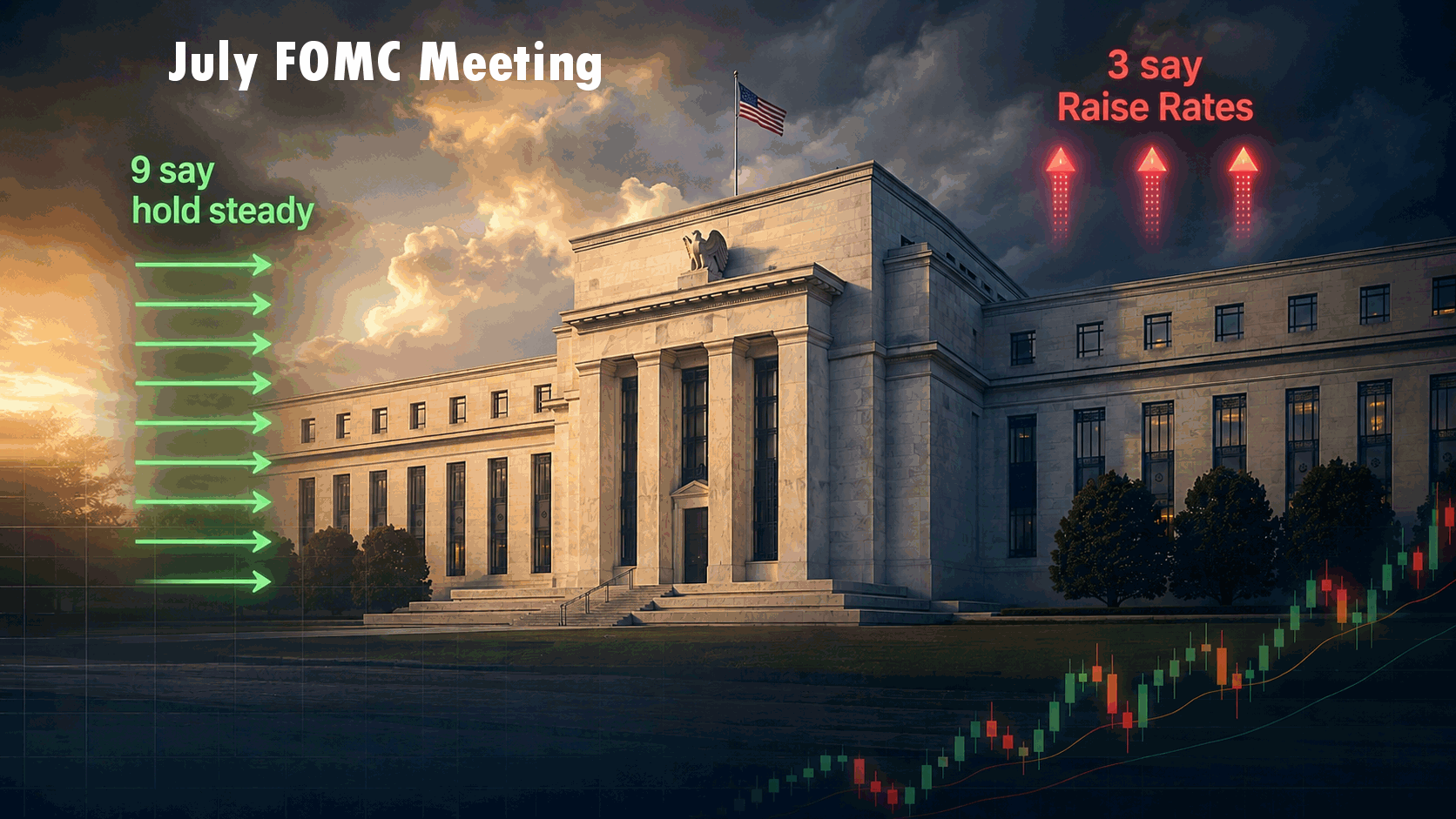
 At the most recent Federal Open Market Committee (FOMC) meeting on July 28 and 29, the Federal Reserve left interest rates unchanged at 3.50% to 3.75%, marking the fifth consecutive meeting without a rate change. While that decision was widely expected, the vote behind it was anything but routine.
The Federal Open Market Committee (FOMC) voted 9-3 to keep rates steady. What caught investors’ attention was that all three dissenting members—Beth Hammack of the Cleveland Fed, Neel Kashkari of the Minneapolis Fed, and Lorie Logan of the Dallas Fed—favored raising rates by another quarter percentage point.
Three governors dissenting in the same direction is rare. In fact, it hasn’t happened since September 2016, highlighting that a meaningful group within the Fed believes inflation remains a greater threat than slowing economic growth. BMO strategist Ian Lyngen described the outcome as evidence of “a Committee with vocal hawks.”
The split also underscores that the Fed is far from unified on the next policy move. Although the majority continues to favor patience, the growing number of officials calling for tighter policy suggests the inflation fight may not be over.
Warsh Keeps Markets Guessing
This was Kevin Warsh’s second meeting as Fed Chair, and once again he delivered a statement with very little forward guidance.
Warsh has been openly critical of the Fed’s traditional practice of signaling future policy decisions months in advance. Instead, he has emphasized allowing incoming economic data—not market expectations—to drive decisions. He has even established a task force to review how the Federal Reserve communicates with markets.
The post-meeting statement reflected that philosophy. It noted that economic activity continues to expand at a solid pace despite uncertainty surrounding the conflict in the Middle East. At the same time, it acknowledged that inflation remains above the Fed’s 2% target more than five years after inflation first accelerated.
What the statement did not include was any meaningful hint about September or beyond.
Markets React to the Uncertainty
Investors generally dislike uncertainty, and Wednesday’s market action reflected that.
The Dow Jones Industrial Average dropped more than 840 points, or about 1.6%, while the S&P 500 lost roughly 0.6%.
The bond market also sent an interesting signal. Short-term Treasury yields fell as investors became less convinced another rate hike is imminent, but long-term yields moved sharply higher. The 2-year Treasury yield declined about 4 basis points to 4.236%, while the 30-year Treasury yield climbed more than 9 basis points to 5.193%.
That steepening yield curve suggests investors may be growing more concerned about longer-term inflation pressures even as expectations for near-term Fed action become less certain.
Following the meeting, futures markets sharply reduced the probability of another rate increase at the Fed’s September meeting. The odds of rates remaining unchanged rose to 41.9%, up from just 24% the previous day.
Investors will now turn their attention to the Jackson Hole Economic Symposium, scheduled for August 27–29, where Chair Warsh is expected to provide further insight into how the Federal Reserve views inflation, economic growth, and the path of interest rates during the remainder of the year.
