
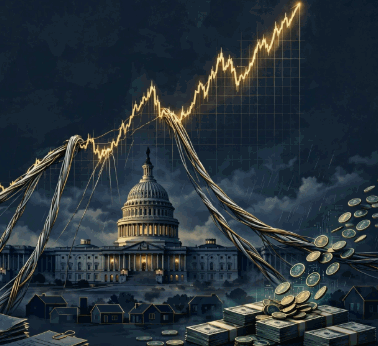
 With the 10-year Treasury yield near 4.7%, it is flashing a warning. A move to 5% would further tighten financial conditions; a sustained march toward 6% or 7% would pose a much more serious threat. So, Treasury Secretary Scott Bessent is looking for ways to contain borrowing costs.
The yield on the 10-year Treasury note may just be the most important price in the U.S. economy. It could very well be more important than any stock index, the dollar, or even the FED Funds rate. So, the question is whether Washington’s financial engineering can once again diffuse America’s fiscal arithmetic.
The concern is not simply that borrowing is expensive today. As the federal debt load approaches $40 trillion and debt relative to GDP is at levels not seen since the aftermath of World War II, the bond market is getting nervous. Interest costs are consuming an increasingly large share of the federal budget. For fiscal year 2026, federal net interest is projected to be 10% more than defense spending, and it buys absolutely no benefits.
The worry is that higher yields can create a negative feedback loop: higher interest costs -> increase deficits, larger deficits require -> more debt issuance, and more issuance without more demand -> can force even higher interest costs.
Bessent’s Counterattack
Treasury Secretary Scott Bessent appears to be signaling that the government is going to fight against a rise in long-term yields.
In September 2011, economic growth was weak, and the FED Funds rate was already near zero. So the FED rolled out Operation Twist. The goal was to reduce the supply of long-term bonds available to private investors, driving their prices up and long-term yields down. Ideally, this would lower mortgage and corporate borrowing rates. Because a short-bond sale or redemption matched every long-bond purchase, it did not increase the Fed’s balance sheet or total reserves in the banking system.
Today, the Treasury Department is considering a similar move. It resembles “Operation Twist,” though with an important distinction: Treasury buybacks are not quantitative easing, and they cannot erase the government’s total borrowing requirement. But they can alter where interest-rate risk sits in the market.
That is also why the policy is controversial. Replacing long-term debt with short-term debt may relieve pressure today, but it leaves the government more exposed if short-term rates remain high or need to be refinanced at even higher levels.
Why the 10-year Yield Matters
The bond market can sound abstract until it shows up in your monthly payment. The sticky part is that mortgages, corporate borrowing, auto loans, commercial real estate, and government financing are all linked to the 10-year Treasury rate. When the 10-year rises, the cost of other capital rises with it.
In 2018, the median price of a new home was $326,400 and could be financed with a 3.5% mortgage. In June of 2026, the median price of a new home was almost $400,000, and financing costs 6.5% or more. So, with a 20% down payment, a 30-year mortgage in 2018 would cost about $1200 a month, while a new house in 2026 would cost over $2000 a month.
That’s a big difference. Higher home prices matter, but higher financing costs turn an expensive home into an unreachable one. The same dynamic hits small businesses looking for loans, companies funding expansion, and consumers financing vehicles.
Bessent’s Wildcard
The most intriguing part of Bessent’s strategy may sit way outside traditional markets or monetary measures and land squarely in the Crypto Universe. Bessent has argued that dollar-backed stablecoins could broaden demand for U.S. government debt, particularly Treasury bills (and increased demand drives the interest rate the government has to pay down).
Bessent hopes that by creating dollar-backed stablecoins, he can lure foreign-held dollars into U.S. based stablecoins. These dollars currently earn interest for foreign banks and finance foreign projects, but the U.S. doesn’t benefit. And there are added risks to the foreign holder, such as local bank or government issues. These dollars are not limited to Europe, but could be anywhere, including Zimbabwe, Argentina, Haiti, or anywhere else.
In addition to security, well-regulated stablecoins offer faster, cheaper 24/7 transfers across borders, avoidance of capital controls, no worries about local bank hours, etc.
If stablecoin issuers hold large reserves in Treasury bills, rapid growth in stablecoin use could create a new, persistent buyer of short-dated government debt. That would make it easier for Treasury to issue bills while buying back longer-dated bonds, which is the same maturity-management logic behind the broader strategy.
The scale is what makes the idea so interesting. Offshore dollar markets are measured in the trillions. Even a partial migration into stablecoin structures could create meaningful incremental demand for bills.
But there are important caveats. A stablecoin is not automatically “backed by the Fed,” and it is not the same as a bank deposit insured by the U.S. government. Its safety depends on the issuer, the quality and liquidity of the reserve assets, legal protections for holders, and the regulatory framework governing redemptions. A stablecoin expansion could strengthen demand for bills, but it could also create run risk if users rush to redeem tokens during stress.
The Real Test
Bessent’s approach may buy time. It may smooth market functioning, reduce pressure at the long end of the curve, and give households and businesses some relief if mortgage rates follow Treasury yields lower. But it cannot solve the underlying fiscal problem by itself.
Markets ultimately care about three things: inflation, growth, and whether the U.S. can credibly finance its obligations without continually asking investors for a higher return. Buybacks and stablecoin demand can influence the plumbing of the Treasury market. They cannot permanently substitute for fiscal discipline.
The bond market is not demanding perfection. It is demanding confidence that America’s debt trajectory remains manageable.
You might also like:
